
The Sound Of A Boundless Imagination
Giancarlo Roversi reveals how music, engineering, grief, philosophy and Venezuela shaped the Pulstarverse, an immersive science-fiction saga exploring memory, identity, consciousness, political collapse and humanity’s fragile certainties through ambitious storytelling.
G iancarlo Roversi is a remarkably imaginative artist whose work refuses to be confined to a single medium. An award-winning author, accomplished musician and trained computer engineer, he brings intellectual precision, emotional intensity and a composer’s instinct for rhythm to the page. The result is the Pulstarverse: an ambitious literary creation in which dystopian science fiction, philosophical enquiry, political observation and original music converge.
At the heart of this universe lies the acclaimed Pulstar Trilogy, a sweeping exploration of memory, identity, consciousness and the uncertain meaning of human existence. From Pulstar I – The Swan Barely Remembers and Pulstar II – Meadows of Involution to the monumental conclusion, Pulstar III – The Cracked Mirror of the Cosmos, Roversi combines suspenseful storytelling with questions that linger long after the final page. His characters inhabit worlds of cosmic mystery and social upheaval, yet their deepest conflicts remain profoundly human: Who are we without our memories? How much can we trust our perceptions? Is certainty anything more than a comforting illusion?
The accompanying prequels, Nerve and Marlenh, further reveal the extraordinary scope of his vision. Every narrative thread, parallel timeline and recurring character contributes to a carefully constructed mythology developed over many years. Yet Roversi never allows the architecture of his world-building to eclipse the people at its centre. His fictional universe may be vast, but its emotional force comes from intimate struggles with guilt, loss, belonging and self-discovery.
Music gives his work another compelling dimension. Having shared stages with celebrated bands including R.E.M., Oasis and Duran Duran, Roversi understands how atmosphere, tempo and tension can shape an audience’s experience. By composing original soundtracks for his books, he transforms reading into something almost cinematic—a meeting of prose and sound that deepens the mood of each scene and makes the Pulstarverse uniquely immersive.
Roversi is a visionary storyteller whose fearless imagination, musical artistry and philosophical depth make the Pulstarverse an extraordinary literary achievement.
What makes Roversi’s achievement especially moving is the personal devotion behind it. The trilogy became not only a creative undertaking but also a refuge during profound grief and the fulfilment of a promise made to his late wife. That history lends his work a sincerity and resilience equal to its intellectual ambition.
For this cover feature, Reader’s House is delighted to celebrate a bold and distinctive creative voice. In the conversation that follows, Giancarlo Roversi reflects on the origins of the Pulstarverse, the sacrifices demanded by such an expansive project, the influence of Venezuela on his fictional nation of Astralvia, and the music, science and philosophy that animate his extraordinary books.
What is the origin of your Pulstarverse? What motivated you to devote decades to creating this rich, complex literary-musical world?
First, thank you so much for this second opportunity to talk about my work.
A single event can change us forever.
When I was ten, I suffered an accident on a small train. I couldn’t walk for a year and almost lost a foot. During these months, I wolfed down science fiction novels, thrillers, and horror books.
Then, when I was a teenager, a guest at my sister’s birthday party began discussing a mysterious concept that captured my attention. This conversation stayed with me, and I felt compelled to explore it deeper. That was the inception of the Pulstarverse.
Years later, the project became deeply personal. What began as creative curiosity engulfed me, turning into a long-term passion and obsession. I became fascinated by the conflicts we humans endure as a species and our unbreakable connection to the universe.
How did your background as a computer engineer and musician influence the complex scientific and rhythmic structure of the Pulstarverse?
I never wanted to study computer engineering. That’s why I endeavored to finish my university studies in three years instead of five; still, knowing about computer technology helped me learn about music production DAWs.
I worked for several years in companies like PDVSA (Venezuela) and P&G. My experience there inspired one of the main characters in Pulstar I and some of its subplots.
By the way, during that time, I published the books Astralvia I and Astralvia II in Spanish, which I considered the drafts for the Pulstar series. Several coworkers bought them. But, a few weeks later, some of them started treating me differently, and a few even became distant. Oops, I still don’t know what they thought of me, though it’s not that hard to guess. Don’t you think?
After fourteen years of development, how does it feel to see the culmination of the trilogy in Pulstar III – The Cracked Mirror of the Cosmos?
Wow, wow. How can I put this without sounding so cliché? Pulstar III is the most challenging thing I’ve ever done. Plus, the last section of this third book was one of the driving forces behind completing the trilogy. Knowing that conclusion exists, and that it’s captured forever, is something that often gives me a glimmer of light in the darkest moments. The effort I had to make, the sacrifices, the losses, and the loneliness I underwent during this project were enormous, but I had no choice. While I was drafting Pulstar III, my wife passed away out of the blue. The Pulstarverse became my refuge, my lifeline, my salvation—especially because, months before this tragedy, I had promised my wife I would finish the trilogy, no matter what it took.
What is the core message you want to convey to your readers?
More than anything, I hope readers finish the trilogy feeling that it has subtly shifted their way of understanding the world. I created Pulstar to entertain and provoke curiosity, reflection, and debate.
Beneath the suspense and adventure lies an invitation to wrestle with larger questions: political, social, philosophical, and deeply personal, even when the answers are unsettling.
The trilogy’s principal theme is how little we know about ourselves, about what is out there, about the meaning of our existence, or if there is any real meaning at all. The characters are driven by forces they barely comprehend, shaped by actions they don’t remember and identities they struggle to reconcile. That tension mirrors something profoundly human: the realization that memory, perception, and self-understanding are far more fragile than we assume.
Ultimately, if there is one message that I’d like readers to carry with them, it is this: certainty is often an illusion. Questioning who we are, what we believe, and how our past defines us can be uncomfortable, but it is also where growth begins.
What were the greatest challenges you faced while translating the manuscripts from your native Spanish into English to ensure the philosophical depth remained intact?
Phew, translating these books has probably been one of the most demanding things I’ve ever done. It’s been so hard that sometimes I wonder if I made the right decision. The key problem was this. When I translated the first books (Marlenh – Nerve – Pulstar I), the Spanish texts weren’t ready, so these translations were useless. I had to rewrite over half of each book and almost seventy percent of Pulstar I. Then, I went back to translate them, and two excellent editors improved the English versions. Based on that, I rewrote the Spanish versions, synchronizing the text with its professionally edited English version. That is, analyzing sentence by sentence in English and Spanish simultaneously.
In Pulstar I – The Swan Barely Remembers, the characters confront a forgotten past; what inspired the concept of escaping a revenge for crimes they committed when their bodies weren’t human?
Imagine being accused of a crime you don’t remember. Even worse, imagine that someone wants to destroy you with a horrific punishment for something that happened in the past when you weren’t fully yourself. What an injustice of fate. What an unprecedented sentence. Plus, that person who craves revenge against you is hatching a much larger scheme, and everyone considers them a savior, a hero.
Memory is something so delicate, so central to our identity. Can we say we are ourselves if we remember nothing? How much of our true selves remains if we don’t even know who we really are?
You have composed soundtracks for each book; how does the music for Pulstar II – Meadows of Involution reflect the “involution” seizing the nation of Astralvia?
I’ve been trying to develop a writing style that is as cinematic as possible, so creating soundtracks for each book is really like a dream for me. I always listen to music when I write—this has influenced my prose. Actually, playlists are my best friends. Music has saved me so many times from writer’s block.
The songs I’ve been composing mirror how I feel about a specific scene in the book. However, the emotions might be otherwise for readers, and I think that’s terrific.
Astralvia is a chaotic nation, but as the trilogy progresses, this turmoil morphs into involution (a regression), but above all, into a lack of logical reasoning and an ode to banality, simplicity, and fantasy. The music of the trilogy grows denser and more enigmatic as this existential decay, which shrouds the entire status quo, becomes rampant.
Your work often explores what it truly means to be human; how has your own interest in the meaning of life shaped the character of Jeral Murh?
Jeral is one of the protagonists of the story—I’d like to explain more, but… You get my drift, right? One of the most significant philosophical themes in the trilogy is the identity crisis that plagues many of the characters. Jeral is the one who carries this burden to the deepest and most dramatic level, above all because she’s one of the few who remembers something of her past, and learning more about her failures and their aftermath, in a cosmic-scale butterfly effect, consumes her from within. Also, she’s an astronomer, and her most ambitious project was to prove the existence of Pulstar, despite how devastating it could be for humanity. You know, the balance of Homo sapiens society is like a rice castle—a slight breeze can destroy it in no time.
Having shared stages with bands like Oasis and REM, do you find that the energy of a live musical performance translates into the high-stakes suspense of your thrillers?
Oops, this is definitely a different question from the rest. Honestly, playing live is much safer and healthier—at least compared to the Pulstarverse books, where the intensity and drama are much greater and more hazardous.
Astralvia undergoes a massive political and social shift in the second book; does this setting draw any parallels to your personal experiences or observations of real-world geopolitics?
Uh-oh, we might spend hours exploring this question. Astralvia is a fictional nation partly based on my native country, Venezuela. The disaster Venezuela has endured for decades influenced the social, economic, and political chaos in Astralvia. In fact, several characters (especially in Pulstar II and Pulstar III) are based on political figures from my country… Ugh! That said, what’s unfolding in Astralvia also bears many similarities to the insane times we’re living in today. A few months ago, my editor and I compared the similarities between the events in the Pulstar trilogy and the reality of the world today. We were both stunned—it’s truly spine-chilling.
The “Pulstarian” universe includes several prequels; how did you manage the intricate world-building required to keep the timeline consistent across these books?
Aha… here we go! The two prequels published so far are Nerve (Noir Sci-Fi Thriller) and Marlenh (Erotic Thriller). Marlenh was simpler because its story takes place about thirty years before the events of Pulstar I. Nerve was more complicated, since its events run parallel to those of Pulstar I, with characters appearing in both books. The major challenge was to ensure that you could read Nerve and Pulstar I as stand-alone novels without spoilers. Now, for Pulstar II, I recommend reading both books. Oh, by the way, you can download Nerve for free from my website.
With your passion for astronomy, how much of the “hard sci-fi” elements in the trilogy are based on current theoretical physics versus purely visionary imagination?
I love this question. Thank you very much. The Pulstarverse is philosophical dystopian hard science fiction, granted, but not that hard. Much of it is based on the theory of consciousness as part of the cosmos, blending it with dark energy and multiple dimensions. And here’s a confession: I’m an agnostic, but the Pulstarverse represents far more than a fictional world to me. The theories I explore in this work have become my beliefs.
You know what? A close friend once suggested that we might found a religion based on the Pulstarverse. Nah! There are already too many, and it requires too much hassle and hot air… Hehe. 😉
What specific writing tips can you offer to aspiring authors who are attempting to build an expansive, multi-volume fictional universe from scratch?
Phew… I’d love to chat with other authors and share our experiences. I would humbly recommend that you never neglect the story and the characters for the sake of worldbuilding and lore. It’s so tempting to immerse yourself in your fictional universe… I’m now creating the Astralvo language. It’s lots of fun: the verbs, the conjugations, the pronunciation… But without a story, without the characters’ arcs, any worldbuilding is just a world full of mannequins.
Based on your journey of surrendering your personal life to complete these manuscripts, what is your most vital piece of advice for aspiring authors who struggle to maintain long-term discipline?
Firstly, I wouldn’t recommend anyone to do what I did. I cut myself off from the world for over a decade and a half. I lost so much.
Now, discipline is vital, no matter the field. In my case, I’ve always forced my way into the zone, even when the dreaded writer’s block is lurking close by. It’s always better to edit, improve, or rewrite something that already exists than to spend weeks searching for the perfect inspiration. I don’t know, that’s just me, but I’d like to know your take on it.
The Fun side of Giancarlo Roversi
If the Pulstarverse had its own national dish, what would it contain—and would humans survive eating it?
Oh, Madonna, what a question. I love it.
Well, since my favorite food is pizza, the national dish of the Pulstarverse would be pizza. It would have a heartbreaking hot pepper, mind-blowing spices that connect your mind to the cosmos, a sauce forcing you to question your existence and the status quo, and an addictive vegan cheese that keeps you craving more and more slices. Then, to soothe the intellectual palate, taste a cake brimming with passion and emotional depth. Oh, would humans survive? Only those who dare to savor every single flavor.
Which of your characters would be the worst person to sit beside on a long-haul flight, and why?
That’s hilarious.
This one’s a breeze. We have several candidates, but the prize for the most unpleasant goes to Edwargh Manzare—an insufferable devotee of the Mother of Zorth who hasn’t bathed in decades. Yuck!
If aliens discovered your books before meeting humanity, what wonderfully inaccurate impression might they form about us?
Oops, they’d likely burst out laughing at humans… and at me. Although… what if these aliens are less evolved than Homo sapiens? What if they can’t read? Or worse yet, what if they like stupid music or AI music? 😉
You have created books, soundtracks, and even a language—what comes next: Pulstar fashion, Pulstar cuisine, or Pulstar therapy?
Pulstar Fashion? Fashion matters to me as much as a dish of broccoli does to a five-year-old. What horrendously ridiculous outfits would come out of that? Cuisine?? For sure, something that doesn’t harm other species. It would be based on solar energy, neutrinos, cosmic dust, and the Earth’s most abundant minerals. Pulstar Therapy… “Please, imagine your neuromagnetic body connecting with the cosmos; dare to step outside the bubble of the human system and have an unforgettable conversation with the universe. I think this friend is a good talker, but you have to pay close attention to the subtext of its language, since it’s often hard to grasp.”
If you were forced to start a Pulstarverse religion, what would its strangest commandment be?
What? Do you want me to start a religion? Sorry, but I don’t know how to sell empty promises to people or lie to them to get their money. Anyway, let’s imagine the commandments. Let’s see… Hmm… I’m still trying to picture such a bizarre scenario… Fine:
Every living being, from insects to Homo sapiens, is equally important to the cosmos. Human beings aren’t special at all.
Nature, the cosmos… they always win. Species at a low evolutionary level (like humans) are just tourists in their biosphere.
It is forbidden not to criticize the current status quo and to fight for a higher and fairer one for all species.
Banality and the ode to ignorance are a deadly poison.
It is forbidden to wage war, one of the greatest signs of backwardness, selfishness, and stupidity.
Phew…. we could go on with many more, but perhaps it all boils down to one thing: evolve or go extinct.
EDITOR’S CHOICE
Bold, intelligent and hauntingly imaginative, Pulstar I transforms dystopian science fiction into a gripping philosophical exploration of identity and reality.
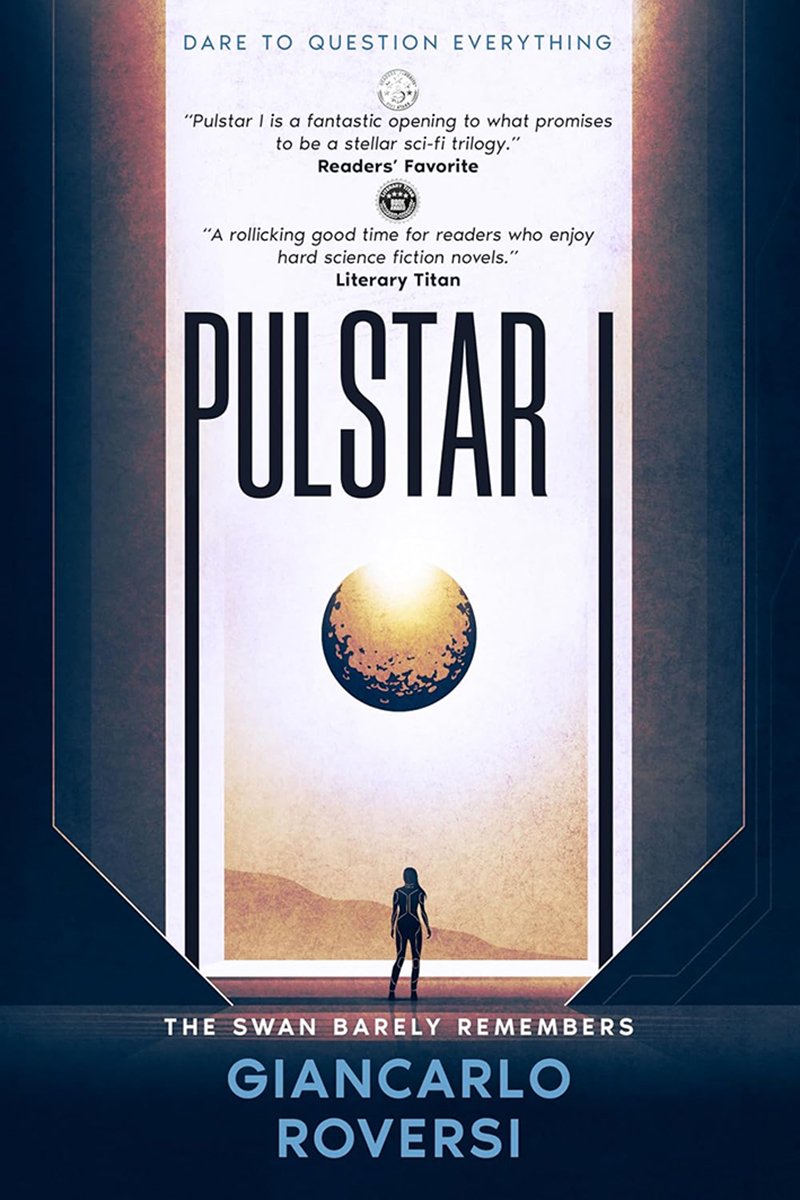
Giancarlo Roversi’s Pulstar I – The Swan Barely Remembers is an ambitious and intellectually charged opening to the Pulstarverse trilogy, blending dystopian tension, hard science fiction, mystery and philosophical speculation into a story that deliberately challenges the reader’s perception of reality.
At its centre is astronomer Jeral Murh, who awakens from a coma with the disturbing conviction that she is not entirely human. Fragments of a forgotten past begin to surface, drawing her towards two former allies and an enemy whose desire for revenge reaches far beyond personal vengeance. The most unsettling revelation is that Jeral herself may have created the very threat now endangering humanity.
Roversi is particularly effective when exploring questions of memory, identity and responsibility. What makes us who we are if our memories disappear? Can we be held accountable for actions we cannot remember? And how much of reality can we truly trust? These ideas give the novel a philosophical weight that distinguishes it from more conventional futuristic thrillers.
The world-building is bold, the mystery develops patiently, and the increasingly high stakes create an atmosphere of constant uncertainty. Rather than offering easy answers, Roversi encourages readers to question almost everything they encounter.
The Swan Barely Remembers is a daring, imaginative and thought-provoking science-fiction novel, ideal for readers who enjoy cerebral storytelling alongside suspense, cosmic mystery and dystopian intrigue.