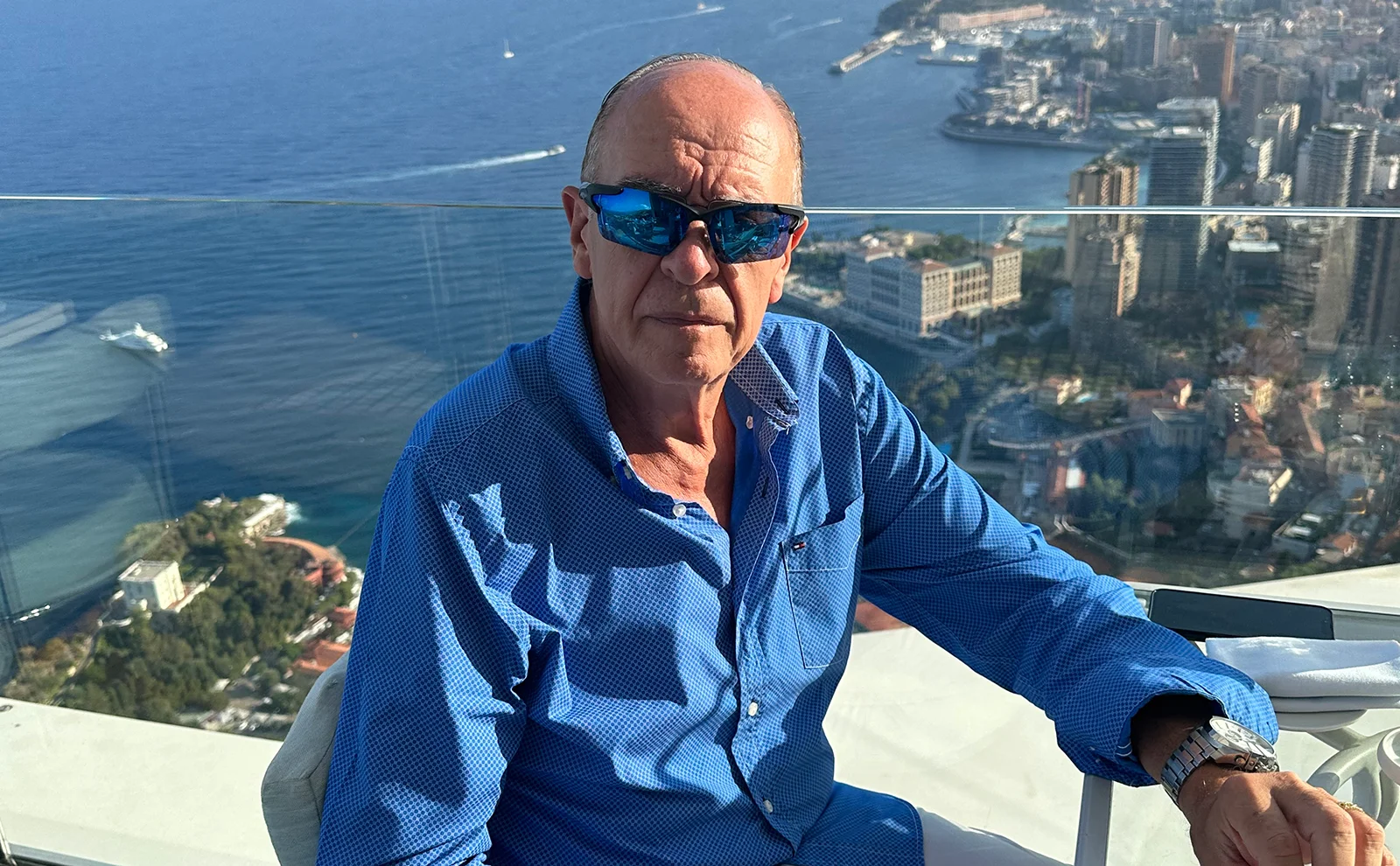
Photo: Patrick Faure: The Visionary Mastermind Behind Surreal Portals of Colour, Philosophy, and Narrative.
A Journey into Contemporary Surrealism
Patrick Faure, a visionary in contemporary surrealism, masterfully combines Mediterranean-inspired beauty, philosophy, and thought-provoking narratives to create immersive, layered artworks that transcend imagination. A true artist-philosopher, Faure’s work captivates and inspires.
Art has the power to challenge perceptions, evoke profound emotions, and transport viewers to another realm. Few artists embody these qualities more strikingly than Patrick Faure, a master of contemporary surrealism. With a unique blend of classical techniques and forward-thinking creativity, Faure’s works transcend mere visual expression. His creations are rich in narrative, philosophical depth, and the mesmerising interplay of colour and texture, making each painting an immersive journey.
In an exclusive interview with WOWwART Magazine, Faure spoke candidly about his journey as an artist, his inspirations, and the vision that manifests in his art. His story is as remarkable as his work—a testament to perseverance, authenticity, and the lifelong pursuit of truth through creativity.
Roots and Inspirations
For Faure, art is a profoundly personal expression. His journey began under the influence of his grandmothers, each introducing him to iconic art movements: one opening his eyes to the evocative world of Italian surrealism through Giorgio de Chirico, the other immersing him in the light and colour of French Impressionism. These early encounters rooted his passion, setting him on a path to create paintings combining imaginative storytelling with meticulous craftsmanship.
A masterful visionary, Patrick Faure infuses unparalleled storytelling, philosophy, and mesmerising colour into surreal artworks worth cherishing eternally.
Faure’s distinctive style draws inspiration from celebrated masters. Hieronymus Bosch, Paul Delvaux, Salvador Dalí, Giorgio de Chirico, and the Flemish Primitives have all left their mark on his vision and techniques. Faure explains that Bosch and Dalí’s intricate surrealism inspired his detailed, otherworldly compositions, while de Chirico and Delvaux informed both his architectural sensibilities and his exploration of existential stillness. Faure often describes his approach as blending the layers, precision, and mystery of the Old Masters with narrative sophistication and dreamscapes that resonate today.
Philosophy on Canvas
Faure considers himself a philosopher as much as an artist. His canvases are intellectual voyages, merging existential inquiries with striking surrealist imagery. He credits his cultural and intellectual upbringing with shaping his artistic themes. Growing up near the monumental Mausoleum of Augustus on Via Julia instilled in him a connection to Roman civilisation, while his academic immersion in the works of European thinkers like Voltaire, Descartes, Camus, and Sartre shaped his deep understanding of life, existence, and human fragility.
His art reflects this philosophical anchor. Each painting is a complex matrix of symbolic narratives. Faure emphasises that his compositions are crafted to unfold in three dimensions: their retinal impact, their historical context, and, finally, their metaphysical depth. The result is a meditative experience, where viewers are encouraged to introspect and find personal meaning in his paintings.
Balancing Tradition and Modernity
What makes Patrick Faure’s technique particularly powerful is his ability to merge traditional art forms with a modern voice. Remarkably, Faure is self-taught and credits his early development to studying the works of great masters in museums such as the Louvre and the Royal Museums of Fine Arts in Brussels. These experiences formed the foundation of his classical technique, but as he evolved, Faure began to explore new expressions. By marrying classical oil methods, like varnishing with modern surrealist ideas, he has crafted a distinctive style. His works—particularly those in what he describes as his “Surrealism Generation 3” phase—combine narrative depth with the beauty of luminous, layered textures seldom seen in contemporary art.
Colour plays a central role in Faure’s work. His Mediterranean heritage serves as the cornerstone of his palette. Shades of blue, inspired by the region’s skies and seas, dominate many of his paintings, creating dreamlike atmospheres that echo his philosophical themes. Earthy tones, however, provide balance, grounding his compositions in the tangible world while still inviting viewers to embrace the surreal.
Evolution and Legacy
Faure’s artistic journey has been marked by continuous evolution. From early portraiture to small-scale surrealist watercolours, followed by grandiose mixed media works incorporating graphite and oils, his career has been a constant exploration of scale, form, and storytelling. The current phase of his work, which he describes as smaller yet richly layered on every level, represents the accumulation of years of craftsmanship and self-discovery.
He attributes his ability to evolve to his unwavering commitment to authenticity. Faure rejects external influence on his creative decisions, believing that an artist must remain true to their own voice. For aspiring painters, his advice is direct: never let anyone dictate your artistic style or compromise your vision. Authenticity, he insists, is the bedrock of great art.
The Visionary Surrealist
Patrick Faure’s body of work remains a bridge between the past, present, and future of surrealist art. Through his intricate narratives, layered technical mastery, and the seamless merging of philosophy with beauty, he has established himself as a progressive force in contemporary art. As revealed in his interview with WOWwART Magazine, Faure’s journey is not only a testament to his extraordinary talent but also an inspiring narrative of dedication to creativity, culture, and truth.
With every brushstroke, this modern master opens a portal into a world where imagination, philosophy, and art converge, proving that painting remains one of the most profound avenues for exploring the human experience.

Leave a Reply