
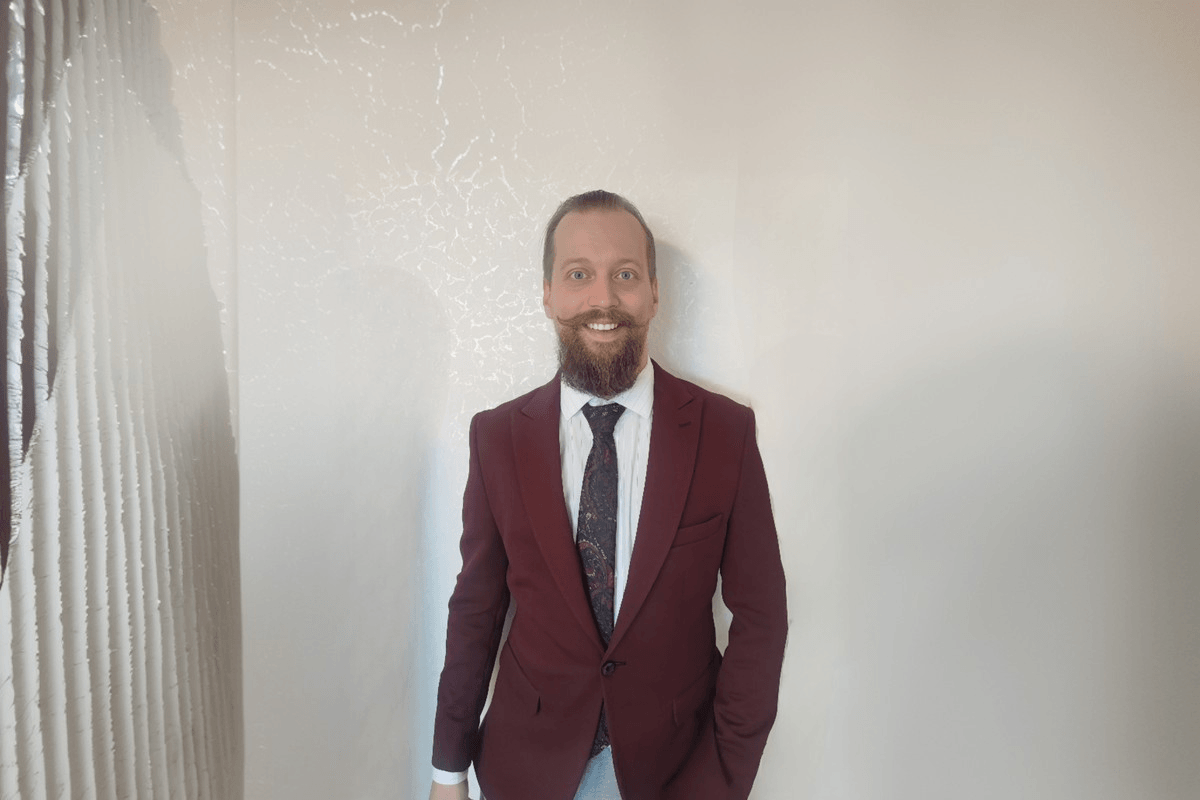
PHOTO: Christoffer Vuolo Junros reflects creativity and intellect, a storyteller and engineer bridging imagination and innovation.
The Intersection Of Humanity And Technology
Christoffer Vuolo Junros, Swedish author and engineer, blends technical knowledge with visionary storytelling to explore futuristic technology, artificial intelligence, and humanity’s enduring quest for understanding in his science fiction worlds.
Christoffer Vuolo Junros is a storyteller driven by questions. Born in Gothenburg and now writing from Stockholm, his work is infused with a sense of possibility, a deep curiosity about what lies ahead, and a respect for the infinite unknowns of the universe. His stories reach toward the outer edges of scientific speculation, yet at their heart they remain tethered to the complexities of human emotion and resilience. From the gleaming laboratories of the future to distant stars, his words challenge us to imagine new worlds while reflecting on our own.
What makes Christoffer’s vision distinct is not merely his understanding of advanced technology — though his expertise as a senior engineer lends a vivid, believable depth to his narratives — but the seamless way he wields these concepts to ask profound questions about our humanity. In his tales of artificial intelligence and interstellar exploration, readers encounter beings that are alien yet hauntingly familiar, and technologies that test the very limits of consciousness and morality. For Christoffer, fiction and engineering serve a shared purpose: they explore how our human spirit might evolve alongside the extraordinary creations of our ingenuity.
As a sci-fi author, Christoffer understands that the future is as fragile as it is vast, demanding both imagination and discipline to shape it. He writes not only with precision but with heart, embracing his role as both a dreamer and a designer of what could be. His journey exemplifies how boundless creativity, anchored in perseverance and wonder, can inspire us all to push beyond the horizons of what we know.
Christoffer Vuolo Junros merges engineering expertise and storytelling brilliance, crafting thought-provoking science fiction that explores humanity’s future and technology’s impact.
Your biography mentions your background as a senior design engineer working for companies like Volvo, SAAB and Husqvarna. How has your engineering experience influenced your approach to writing science fiction?
As an engineer, I’ve spent years turning ideas into reality, and that mindset naturally shapes how I write science fiction. When I build the world around my characters, I try to imagine how they use technology to their advantage, and how that same tech could also be used to set them free, physically or mentally. And of course, how it might be used against them.
“When I write, I often start with a simple question: What current problem could be solved through future science?” – Christoffer Vuolo Junros
In your writing you clearly merge technical knowledge with imaginative storytelling. Can you walk us through your process of transforming a scientific idea into a compelling narrative arc?
I’ve always believed that advancements in technology are one of the key forces pushing humanity forward. When I write, I often start with a simple question: What current problem could be solved through future science — and what would that mean for the people involved? For example, when exploring faster-than-light travel, I wanted to move beyond classic warp drives. I imagined using tachyons — faster-than-light particles — to wrap a ship in a cocoon of energy that warps the space around it, shortening travel time between galaxies.
“Advancements in technology are one of the key forces pushing humanity forward.” – Christoffer Vuolo Junros
Your stories often explore the relationship between humanity and artificial intelligence. What draws you to that theme, and how do you make your AI characters feel both alien and relatable?
My AI characters aren’t just logical systems; they reflect human flaws, fears, and compassion through a different kind of consciousness. Through them, I explore what defines us as humans, and whether awareness or empathy is uniquely ours. Writing AI is like holding up a mirror to humanity — and realizing the mirror might be conscious. When does artificial intelligence simply become intelligence? In the end, we have to ask ourselves: at what point does artificial intelligence simply become intelligence?
“My first book balances humour, adventure, and leadership to remain accessible while exploring larger worlds.” – Christoffer Vuolo Junros
What was the moment you realised you wanted to become a full-time or serious writer, rather than just someone who enjoyed writing on the side?
My writing journey is a long one. I’ve always enjoyed writing, but the moment I decided to truly commit was when I realised, why shouldn’t I write an entire book? Nothing was standing in my way. The journey would surely be filled with challenges and knowledge to gain. And if there’s one thing I live by, it’s that there’s always more to learn. The learning curve never reaches its apex.
Your book “Origin Andromeda: The Beginning” launches a series — how did you balance setting up a convincing world and characters in book one without overwhelming the reader?
In my first book, I deliberately kept the tone lighter, leaning toward humour, adventure, and leadership, both to develop my own writing and to make the story accessible. I wanted the book to feel large and diverse, but still enjoyable and digestible, something you could read on the beach or during a train ride. That balance made it easier to introduce both the world and its characters without making it feel too heavy for the reader.
How do you keep the technological aspects of your stories accessible to readers who may not have a science or engineering background?
That’s something I’ve thought a lot about. As the nerd I am, I love diving deep into the details, figuring out exactly how and why something works… or doesn’t. But early on, I received valuable feedback suggesting that I tone some of that down, to make it easier for readers to stay immersed in the story. Now, I focus more on how technology is used and only briefly on how it works, instead of describing it down to the last circuit board.
What has been your toughest writing challenge so far (for example world-building, character development, pacing, or perhaps marketing), and how did you overcome it?
There have been many, but if I had to choose one, it’s marketing. We live in a global world where readers have access to an incredible amount of well-written stories. So how do you stand out? Early in my first book launch, I tried too many approaches at once, and it nearly burned me out. Eventually, I found that the key was community. Other authors, readers, and creators. Supporting each other, reading each other’s books, leaving reviews, celebrating every success, that’s what truly makes the difference. It’s both grounding and motivating.
Collaboration and critique can be vital for authors. Do you use beta readers or a writing group? If so, what is one piece of feedback you received that radically changed your story for the better?
I have two dedicated beta readers who’ve been with me since the first book. They provide a vital sense of security for me as a writer, helping me see the story from an outside perspective and improve the final result. I could mention several pieces of feedback, but one that changed things most radically wasn’t about the story itself. It was the suggestion to include a Dramatis Personae — a character reference page at the end of the books. Creating that became a game-changer, for my own character development and for readers navigating the series. It’s something I now recommend every author consider adding.
With your interest in “futuristic technology” and “boundless possibilities of the future” (as you describe), how do you choose which speculative or cutting-edge concepts you will explore in your next book?
A good example can be seen in the second and third books of my Origin trilogy, where I develop a collective hive mind — of an ancient, super-advanced AI species that inhabits asteroids as their base. Their role is to act as “wardens” or “supervisors” of inhabited planets across nearby galaxies. They were created by an ancient civilization and continue their purpose even today. To me, that’s a perfect example of the kind of boundless possibility that might one day exist in reality.
Looking ahead to the future of the publishing world, especially for indie or genre authors, what trends do you see emerging — and how are you preparing for them?
In the indie world, I see and feel an incredible sense of support among writers. We celebrate each other’s successes and share the same dream of reaching as many readers as possible. It’s amazing to find friends and fans among fellow authors. It’s a generous community with no limits to its support. I’m deeply grateful to everyone who’s shown me encouragement, sharing my books, offering feedback, leaving reviews, expecting nothing in return except friendship. Thank you all.
Finally, for other writers out there who are working on their first novel or trying to break into the genre: what one piece of advice would you give them that you wish you’d known when you began?
Don’t write for the market — write for yourself and your future readers. Be genuine. Don’t try to force or fake the writing. It’s perfectly fine to have days, weeks, or even months when the words don’t come. For me, those are often the times when the subconscious works in the background. That plot problem you couldn’t solve, that missing piece you needed to move forward, it often reveals itself when you least expect it. Sitting on the subway, talking with a friend, even during a boring meeting. Inspiration often arrives quietly — in the moments between. That’s when the story finds you.