
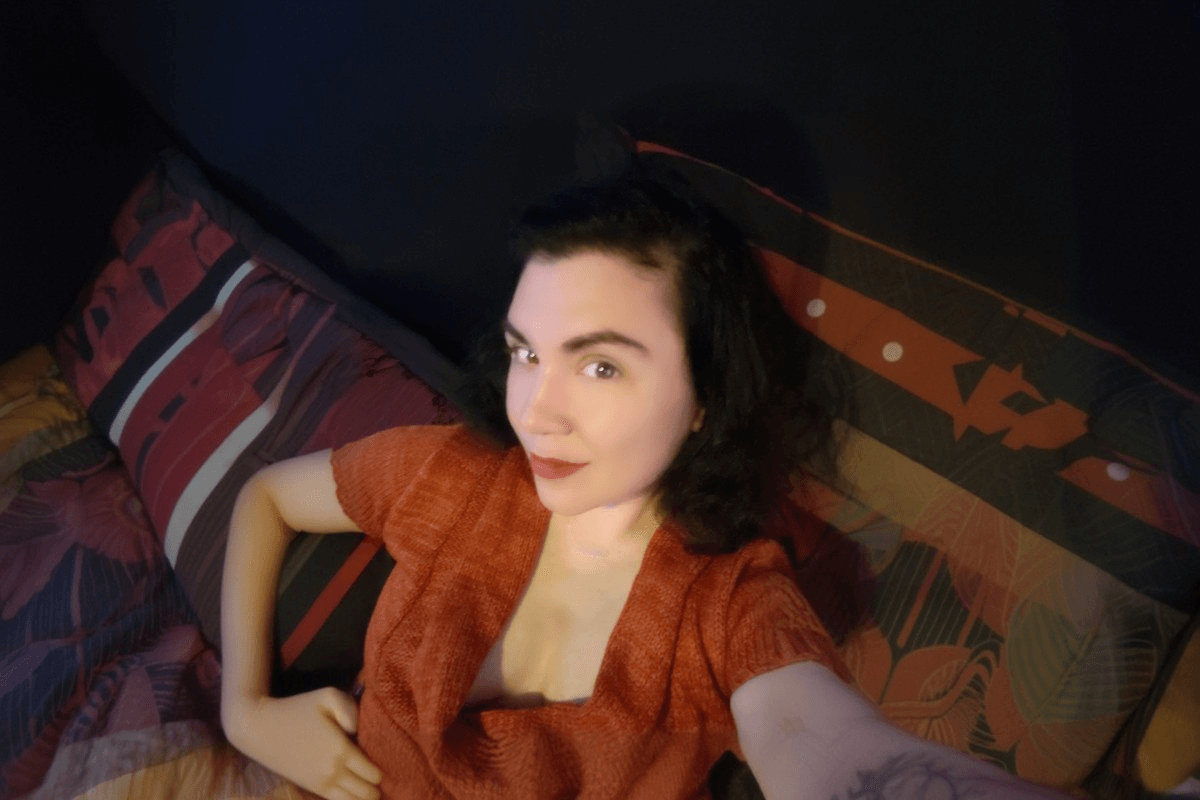
PHOTO: Amanda Johnston, author of The Anthem Saga, captured in contemplation of her literary universe.
A Visionary Crafting Worlds Of Angels, Demons, And Dark Romance
Amanda Johnston discusses the creation of The Anthem Saga, her unique inspirations, and the endurance required to weave intricate mythology into a ten-book supernatural series across nine months.
Amanda Johnston is a storyteller who writes with an urgency born of passion—an artist who, once compelled by an idea, cannot rest until it takes form. Her awe-inspiring creative feat—completing The Anthem Saga, a sweeping ten-book series, in under a year—speaks not only to her impressive discipline but to a mind brimming with worlds, characters, and lore that demand to be set free. Inspired by music, mythology, and deeply human struggles, Johnston crafts tales that pulse with life, inviting readers into realms grand in scale yet intimate in their emotional depth.
The heart of The Anthem Saga beats with a rhythm both raucous and tender. Through the haze of engine roars and city lights, her characters, whether angelic, demonic, or human, wrestle with fate, faith, and fear. They navigate a universe stitched together from theology and rebellion, shadowed streets and sacred realms. At its core, her work is a reflection on hope and heartbreak, on enduring the unendurable, told in prose as raw and touching as the stories themselves.
Yet Johnston’s creative muse is anything but predictable. From the darkened corners of New Orleans to the grandeur of mythological realms, she threads fresh perspective into familiar tropes, turning the expected upside down with wit and conviction. Her ability to balance the weight of trauma with threads of adventure shows a deft touch, inviting readers not only to escape into satire, action, and romance but to feel deeply and reflect meaningfully.
In all of her endeavours, Johnston invites us to linger in the grey—the space where good battles evil, love breaks open the heart, and redemption feels both fragile and fierce. Her works remind us that even in the darkest of nights, there is a promise of light—and that it is the stories we tell and believe that shape the worlds we inhabit.
Amanda Johnston crafts worlds and characters with unprecedented creativity, seamlessly blending mythology and human emotion in breathtaking storytelling.
What first sparked the image of Johnny Viridian in your mind, and how did that single idea swell into a ten-book saga?
When Meat Loaf’s Bat Out of Hell II: Back Into Hell came out in the early 90’s my dad bought the album. At the age of around eleven I started stealing the cassette and I would go into my room, sit in total darkness with headphones on, and while I listened I’d imagine this story of a man on a motorcycle plunging into the bowels of a city to save the woman he loved, an angel, from demons who wanted to turn her to their side. Johnny and Jenny’s names come directly from the song Good Girls Go to Heaven (Bad Girls Go Everywhere). Johnny evolved from there until I finally wrote him in 2018, twenty-two years later.
You wrote fifteen novels in seventeen months: what daily rhythm or survival strategy kept your creativity and health in balance during that marathon?
I used to say that I wrote in the margins. Any spare second I got in the early days I was at my computer. I’d give myself an hour to get down 1200 words, sometimes I got through more. There were a lot of late nights and early mornings. I even took my laptop on family holidays and wrote at the end of the day or during rest breaks. There were many times I’d have a child on my lap typing around her while she played on her tablet, or typing with one hand, a sandwich in the other.
The stories come to me like movies in my head I’m just transcribing, and I just tap into “the feed” and get going.
Anthem City is almost a character in its own right; which real cities or personal memories fed into its streets, moods and blackout nights?
Anthem is a mix of cities patched together. I spent my 20’s in Birmingham, Alabama on the South Side. I was the lead singer of a rock band, Sorrow of Her Evil, and we played shows in town every weekend. I loved the city at night time and always felt at home in the older sections of the city. The French Quarter in New Orleans is another place I instantly felt like I belonged. I brought New Orleans in more in the later books (the Rue Royale Novels). Then stitching everything together is the fictional city which is a mix of Gotham, and some other major city that never really existed except in the nostalgia of a Bruce Springsteen or Jim Steinman song. The ensemble cast of the play, really.
“Bad things happen to good people, and that those things have to happen for the world to keep turning.” – Amanda Johnston
Limbo, Heaven On High and the Starlings each carry distinct mythologies; how do you track the lore, timelines and power-rules across books so nothing contradicts?
A lot of the lore is based on Christian theology and mythology. I have always been interested in angels and demons, and pulled a lot from the gnostic gospels. With that kind of base I filled pages of what one of my closest friends and another author, Stacie Hanson (Twisted Faire, The Unseen novels), calls a “story bible”. A lot of the time I can just pull the rules of the realm from memory, but for places like Nastrond that I basically invented from scratch I needed to have the guide. Physics works differently in Nastrond, time moves differently, so that I needed to keep particular track of.
For Saraqael and her Starlings it struck me as a very funny commentary on the “prosperity gospel” that televised pastors espouse. To have a demoness with a beautiful face on television, preaching to people who are buying her particular brand of fire and brimstone out in the open plainly was so unexpected even to myself when it came to me that it made too much sense for the character and the story.
“A lot of the lore is based on Christian theology and mythology.” – Amanda Johnston
Gwyneth and Jenny endure huge emotional upheaval; how do you approach writing authentic trauma without letting it swallow the adventure?
One of the main rules of the Anthemverse is that bad things happen to good people, and that those things have to happen for the world to keep turning. Personally, I’ve experienced some incredible tragedy as well as witnessing it second hand, and what happens is that it informs every choice and decision after whatever it may be, moving life along. Jenny and Gwyn have to face these things that happen head on. Oftentimes Johnny, Billy, or Jaicimus get stuck in the muck when something happens, and their way of coping is to shut it off entirely or burn something down. You have two options; let the trauma eat you alive, or trudge on until you can see the light again. Someone has to use the bad for good, in the end, or there is no point to living.
If you could resurrect one character you’ve killed off, who would it be and what storyline would they unlock?
Since the Angel of Death is a big part of the story I’ve played with the broken death trope quite a bit. I know some people hate that but I love taking a trope and making the characters address it. For instance, in the 6th, 7th, and 8th books of The Anthem Saga I made it my goal to include every vampire and YA novel trope I could cram into them and make the characters almost break the Fourth Wall with them.
That said, I think if I could bring someone back that I have left deceased it might be Ezekiel. He was so precisely evil that he was fun to write. Bringing him back after everything that has changed and transpired would likely blow his mind, and it would be interesting to see if he accepts being at the bottom of the food chain or if he’d try to stir trouble.
The saga blends vampires, angels, demons and human politics; which genre label makes you cringe the most when applied to your work?
It doesn’t necessarily bother me or make me cringe, but I feel like it’s misleading to a point to call the books any kind of “fantasy”. When I think of fantasy I think of unicorns and fairies, not motorcycles and rock bands. I feel like a better label would be “supernatural alternative nostalgia”, if such a genre existed. Maybe it should be coined.
“Writing to the market works for some people, but what makes an expansive world real is organic.” – Amanda Johnston
What three habits or mindset shifts would you urge on new authors who dream of building a vast series without drowning in their own lore?
Don’t sit on a story idea or plot twist, just write it. It can always be changed or expanded on later. The second major thing is not to box yourself or your story in. Writing to the market works for some people, but what makes an expansive world real is organic. What world would you, as the author, want to live in? Let it come as it will and don’t hold the steering wheel too tightly. Lastly, be your own story’s biggest fan. I’ve been into some of the major fandoms and one thing about mega fans is that the lore comes back to them in an instant. If you believe in it, it’s not hard to navigate the deepest parts of the lore you build for your own worlds.