
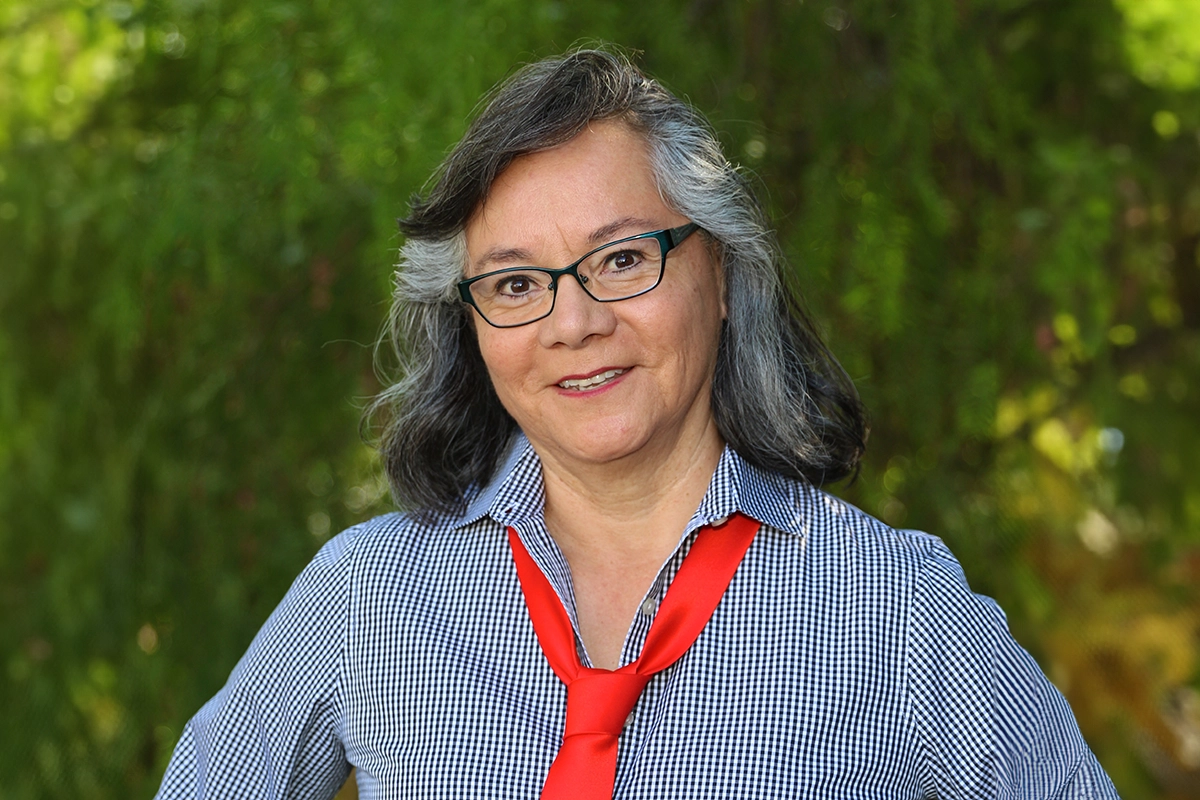
Photo: Veronica Gutiérrez: Author Of The Gripping Yolanda Avila Mystery Series, Championing Representation, Cultural Heritage, And Social Justice Through Fiction
Mystery, Culture, And The Resilient Spirit Of Boyle Heights
Veronica Gutiérrez discusses her celebrated Yolanda Avila Mystery series, exploring identity, cultural heritage, social justice, and LGBTQ+ representation with gripping stories rooted in the vibrant community of Boyle Heights, Los Angeles.
T here are few voices in contemporary fiction as riveting, authentic, and culturally rich as that of Veronica Gutiérrez, a rising star in the literary world and a force to be reckoned with. As the formidable mind behind the Yolanda Avila Mystery series, which includes the acclaimed novels As You Look and Buried Seeds, Veronica’s work is a masterful blend of gripping storytelling and vibrant cultural exploration, deeply rooted in the richly layered community of Boyle Heights, Los Angeles, where she was born and raised. A former community organiser, civil rights attorney, and corporate executive, Veronica brings a wealth of life experience to her writing, making her novels not just page-turning mysteries but also profound meditations on identity, justice, and the struggles of marginalised communities.
Veronica’s protagonist, Yolanda Avila, is a uniquely powerful queer Latina detective navigating both personal and societal complexities. With a profound sense of place and a compelling connection to the idea of community, Veronica transports readers into a world many may never have encountered in the pages of popular fiction—one that pulses with life, resilience, injustice, hope, and the unrelenting fight for equity. Add to this her incorporation of mystical traditions like curandería and Juju, and you have a storytelling palette that seamlessly layers deeply personal narratives with larger social realities, crafting mysteries that engage the intellect, captivate the imagination, and speak directly to the heart.
Veronica’s achievements are many—a Goldie Award nomination for her debut novel, a self-published cocktail journal titled My Little Black Cocktail Book, and her innovative contribution to nonprofit work through creative community endeavours like “Mixology on a Mission.” But beyond the accolades, it is her deep love of storytelling and her commitment to infusing her novels with cultural and social truths that set her apart. As an uthor, she boldly reshapes the literary landscape, offering stories that are as relatable as they are revolutionary.
Veronica Gutiérrez is a writer who challenges the status quo and inspires her readers. Her books are a celebration of identity and place, an homage to the unforgotten histories of diverse communities, and a testament to the transformative power of literature. It was a privilege to sit down with her for this interview and delve into the mind behind the mysteries. Without a doubt, her work will continue to leave an indelible mark on readers and the literary world alike.
Interview Highlights:
- The inspiration behind Yolanda Avila and connections to Veronica’s personal experiences.
- The cultural and historical importance of Boyle Heights in her storytelling.
- The infusion of spiritual elements like curandería and Juju in her mysteries.
- Balancing personal struggles with complex investigative themes in her novels.
- The seamless weaving of social justice issues such as gentrification, immigration, and racial equity into the crime/mystery genre.
- Veronica’s writing process and how her walks inspire her creative flow.
What inspired you to create the character Yolanda Avila and how much of her reflects your personal experiences?
I first read all my sister’s Agatha Christie books as a teen, then loved Sarah Paretsky’s V.I. Warshawski, Julie Smith’s Skip Langdon, and Cara Black’s Aimee Leduc. I especially liked the badass women investigating crime and injustice, but also the way each writer made Chicago, New Orleans, and Paris another character. I had yet to come across lesbian characters closer to home. It took me a while to find the incomparable Katherine V. Forrest. For a while after that, I couldn’t get enough of books with lesbian characters from Bella Books, Bold Strokes, and other publishers. But again, not someone Latina like me. So, I decided to give writing a try. And after my first book As You Look was nominated for a Goldie Award along with Katherine V. Forrest, I was blown away! She ultimately, and deservedly, won, but I had to keep going. Buried Seeds came to be. As for Yolanda Avila, she is very much a composite character, but her ethnic background and some childhood experiences, are definitely from my own childhood.
How do your experiences as a community organiser and civil rights attorney shape the narratives in your novels?
As a former civil rights attorney from a family of community activists, it just seems natural to focus on those themes. The multicultural history of Boyle Heights demands it. I’m glad it does.
I use a lot of what I learned as an organizer and as a civil rights attorney in my writing. Some of my characters are organizers or are their friends. There’s a deep commitment and endless hope endemic to organizing work that I try to portray in my books. The same goes for civil rights litigation. It also helps to know the law a little to portray legally ambiguous scenarios with authenticity.
Can you share insights into the cultural elements in your books and how they play a role in the storytelling?
The culture and subcultures of my Boyle Heights community are exactly what I want to bring to life in my writing. The mass media rarely portrays the real history and cultural richness of this Los Angeles immigrant community. There is something really special about a place that has hosted so many immigrants of various ethnicities. Each group embraced this country in a way often overlooked. And as each group has passed through, they’ve left a significant imprint. In As You Look I focused on the Latino community in which I grew up. In Buried Seeds I dive into the relationship between an undocumented Latino man and his grandfather figure, a Japanese American survivor of a World War II American concentration camp. In a future novel I will address the contributions for the vast Jewish community that played such an important role in Boyle Heights’ original prosperity. Each of these groups found Boyle Heights when other parts of Los Angeles barred them from owning, and sometimes renting, property.
What challenges did you face while transitioning from civil rights work to becoming an author?
I don’t know that it was all that much of a challenge. I worked on constituent services for local elected officials prior to practicing law. The work was hectic and all-consuming. Practicing law, by contrast, gave me a chance to write and the time to do it thoughtfully. If anything, practicing law helped my writing.
How do you balance Yolanda’s personal struggles with the complexities of the cases she tackles?
Like most minorities who live between two worlds and engage in code-switching to come across authentically at home and professionally in the work place, Yolanda is experienced in compartmentalizing to focus on critical matters at hand, whether her own grief, psychic uncertainty, love, puzzling facts, or physical threats.
Juju plays an important role in your novels. Can you explain its significance and why you chose to incorporate it into your stories?
Otherworldly experiences were not uncommon in my family and community growing up. Spiritual healing, or curandería, was something most people I know had experienced or witnessed. It could be something as simple as body scanning with an egg and a prayer or feeling a spirit in a room. I think this happens in many communities, but I grew up in one where talk of it was normal. I wanted to portray it as something commonplace, maybe still a bit unexplainable, but commonplace nonetheless.
How do you approach writing about important issues such as gentrification, immigration, and racial equity within the crime/mystery genre?
So much of our condition in minority communities is informed by wealth disparity, institutional racism, and legal barriers, that it would be difficult to not write about them. It wouldn’t seem authentic otherwise.
How has your background as a QPOC influenced the relationships and dynamics you portray in your books?
This is a very important part of my books. I approach my lesbian characters Yolanda Avila and her wife Sydney Garrett as perfectly normal, but they also come across as having a very solid relationship. It was important to me to have them be free of the petty drama often depicted in lesbian relationships on television.
What do you find most rewarding about creating a mystery series centred around a queer protagonist?
Most certainly, the warm welcome from the LGBTQ and QPOC communities who truly welcome the normalization of our relationships. In my books, my protagonist just happens to be a lesbian in a committed relationship, but it’s especially gratifying to see how hungry people are to see themselves represented in a positive light. I’d say the most rewarding exchange happened at a conference where I shared a panel with Britain’s own JP Preston. When asked to name the first book where we saw ourselves portrayed, JP mentioned As You Look because of the close family relations I portrayed. Well, I was over the moon!
Do you have a specific writing process or routine that helps you craft these compelling mysteries?
I go on long walks where I work out a lot of dialogue in my head. Sometimes it answers questions I’ve been noodling, or it points me in plot direction that sometimes surprises me. Then I write down as much as I can as soon as I get home. After that I check my “living outline” to see if it needs to be tweaked to keep writing forward.
Who are the authors or books that have influenced your own writing style, particularly in the crime/mystery genre?
The authors I mentioned above have influenced my love of the mystery genre. Additional authors like Naomi Hirahara, Tracy Clark, Stacey Lynn Miller, Cheryl A. Head, Carlos Luis Zafon, Ramona Emerson, and Attica Locke are my latest favorites. You can tell because I have all of their books!
What advice would you give to other authors who want to incorporate personal experiences and social issues into their storytelling?
Do what feels authentic to you. The reader will be able to tell if you are faking it. The more real the feelings you and others had in reality, the more authentically they’ll appear on the page.