
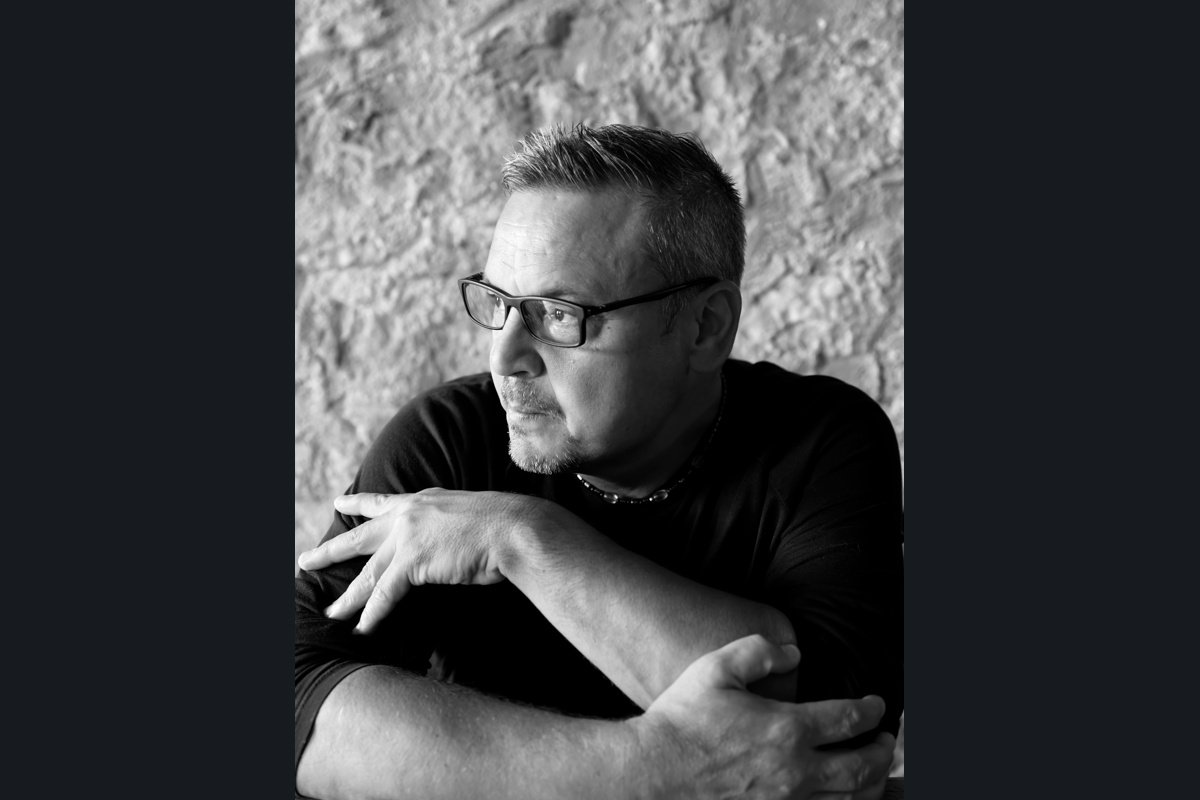
Rio Youers writes about danger with a firm belief in what makes readers care: the human being at its centre. His fiction may travel through horror, crime and relentless action, but the emotional anchor remains recognisable. Parents protect children, friends keep secrets and apparently monstrous people possess histories that complicate our judgement. His reflections on those connections reveal an author attentive to the inner life of a story, as well as the momentum that carries it forward.
Lola on Fire, No Second Chances and The Bang-Bang Sisters offer different expressions of that approach, ranging from a mother’s fierce devotion to the exuberant collision of rock music and vigilantism. Westlake Soul holds a particularly personal place in his account of creative risk, while What They Did turns towards friendship and the consequences of a buried past. His adaptation of Sleeping Beauties adds another perspective on the choices involved in shaping narrative. Thoughtful, funny and disarmingly candid about the business of writing, Youers makes a persuasive case for characters who breathe on the page. This conversation celebrates a storyteller whose imagination is matched by a lasting commitment to emotional truth.
Interview by Ben Alan
Your novels blend thriller, horror and deeply emotional storytelling with remarkable ease. What first drew you to writing stories that explore both the darkness and the humanity of your characters?
Firstly, thank you. I’m happy to hear that it looks easy on the page, because the process, often, is not. I’m a slow writer; I deliberate for far too long over nearly every sentence. Can it be tighter? Does it say what I need it to say? Can I say it just as effectively with fewer words? Honestly, I just need to chill out and write. I’m deeply envious of novelists who can crank out 2,000 words before lunchtime. When I grow up, I want to be just like them.
But yes, back to your question: We’re all formed in different ways, with different interests. Growing up, I was never into cricket or rugby, but I love football. I’m not big into prog rock, but I enjoy classic rock. I don’t read a lot of high fantasy, but I’ve always enjoyed digging into a horror or dark thriller novel. These were the books that got me into reading, and subsequently into writing. When I sat down to write my first “serious” short story (which turned out to be seriously bad), I simply followed the way I’d been formed—the contours of my interests, enjoyments, and fascinations. It’s a trend I’ve been following ever since.
Most of it, I think, has to do with the characters I create. I get a kick out of exploring what makes bad guys tick. Similarly, I’m drawn to my more decent-hearted characters, and seeing how they react when I turn their worlds upside down. I like tapping into them and uncovering their inner strengths—seeing exactly what they’re capable of in the face of adversity. The ultimate reward, of course, is seeing the protagonist come out on top, while the antagonist gets what he or she deserves. It’s the big payoff—that moment when you leap out of your seat and punch the air. I was drawn to it as a young, big-eyed reader, and I’m still drawn to it as an old, slightly jaded author.
The Bang-Bang Sisters combines music, friendship and vigilantism in a way that feels completely original. What was the spark that brought this unforgettable story to life?
Yeah, I had such a blast with this novel. I wanted it to be big and fun and chaotic, not to take itself too seriously, while at the same time touching on serious, human issues: Family, friendship, love, trust, betrayal, hope, and heartache. Throw a healthy measure of rock and roll on top, and you have a recipe for a damn good time.
Most of my stories begin life as a baby bird of an idea—this raw, ugly, flightless thing that squawks to be fed on an almost constant basis. So I feed it one delicious, wriggly worm at a time, and it eventually develops feathers and takes flight. The Bang-Bang Sisters was a little different, because it didn’t start with an idea; it started with the characters: Brea, Jessie, and Flo, an all-female rock band—a drummer, a bassist, and a guitarist—touring the US in their beaten-up old van. They lived in my head for the best part of two years, waiting for the right story to come along. And I knew they had a story to tell. It was just a matter of landing on the right one.
I don’t remember where I was or what I was doing at the time, but at some point it occurred to me that Brea, Jessie, and Flo were vigilantes as well as musicians, and that they toured the country as much to take out bad guys as play rock and roll. Those two worlds worked enticingly well together, I thought: Play a gig, pack up your gear, go kill a bad guy, then move onto the next town. I mean, come on … how much fun is that?
As soon as these two seemingly separate but entirely harmonious concepts came together, the rest of the story—the plot, the other characters, the location, the twists—all fell into place. Hand on heart, it was the most fun I’ve ever had writing a novel.
Lola on Fire is packed with relentless action, yet its emotional core is what stays with readers. How do you strike that balance between suspense and genuine human connection?
Again, it comes down to the characters. I work very hard to make mine as real and relatable as possible, because I know I’ll be taking the reader on a journey that is outside the realm of their usual day-to-day life. Readers need an anchor—something that keeps them in place, keeps them secure, no matter how rough the water gets. I can’t speak for other writers, but for me that anchor has always been the characters. The human element in an inhuman environment is the true driving force. Without it, the suspense and action run the risk of collapsing.
I don’t want to reveal too much about the story, but Lola on Fire, away from all the bullets and action, is about a mother fighting to protect her children. At its core, it’s an emotional, heartfelt, spiritually connecting novel about a mother’s love. Readers, I think, gravitate and respond to that side of the story first and foremost. It grounds them . . . but it also elevates them. It’s like holding the hand of someone you trust while riding on a rollercoaster.
So yeah, to answer your question, I strike that balance by creating strong, believable, relatable characters. That’s always the intention, at least. Readers’ mileage will vary. Like I said earlier, we’re all formed in different ways.
Stephen King praised No Second Chances for its unforgettable villain. What do you believe makes a truly compelling antagonist?
I’ve always found this subject fascinating, to the extent that I wrote an article about it for CrimeReads called My Beloved Monster: Creating the Characters We Love to Hate. I would encourage readers of this interview to go online and check out that article. It’s a fun one!
Of course, I’ll summarize here what I wrote in more detail in that piece—that readers need to connect to the villain every bit as much as they need to connect to the hero of a story, which means they need to have a heartbeat (the villain, not the reader, although it helps if the reader has a heartbeat, too). A soul. They need to feel real, flawed, and human, and have a backstory that elicits an element of empathy. It sounds easy to do, but it isn’t. For me, I find it helps to develop an off-the-page relationship with my antagonists—to converse with them and endeavor to understand what makes them tick. Most importantly, I need to forgive them for their sins. I know that sounds crazy (how do you forgive a character that lives in your head?) but the way I see it, in order to truly understand their motives and lack of moral code, I need to get close to them, and that closeness is established with forgiveness.
Ultimately, it comes down to this: Everyone is the hero of their own story. Even the villains. They’ve been directed by a different set of circumstances, both personal and societal. Usually, the best villains are victims, too, wronged or upended by something or someone somewhere down the line. Is anyone pure evil, utterly beyond redemption? Maybe, but the author won’t know this until they go into deep and personal territory, and the most compelling antagonists are created by authors who understand this.
Your novels often place ordinary people into extraordinary and dangerous situations. What fascinates you about exploring how people respond when everything they value is suddenly at risk?
I’ve always found human behavior fascinating, watching how different people react to different situations, how they attack problems, what they do in those fight or flight situations. I used to play a videogame called The Sims—a life/people management simulation. I suppose there was a point to the game, a final goal, but I played it in a more sadistic, interested way. I’d remove all the doors in a room, so my little computer people would be stuck inside, or delete the refrigerator—sometimes the toilet, too—just to see how long it would take before everyone went crazy. I do something similar now, I guess, in my writing.
It reminds me of a novel by Stephen King called Under the Dome, where an entire town is covered by an impenetrable glass dome. No one could enter the town, and no one could get out. Obviously, things went about as well as you’d expect them to. If memory serves, it turned out to be a kind of social experiment conducted by aliens. What happens to these humans when I do this?
That’s probably the question I ask most often when I write. I cover my little humans with a glass dome and say, okay, let’s see what you’ve got. I’ve simplified it greatly, of course, but that’s the gist. I want to see how resourceful my characters can be when pushed—how much they can go through and still emerge on the other side. Tenacity, ingenuity, inner strength, the triumph of the human spirit. It’s inspiring, it gets the best out of me, and it’s the key ingredient to all my favorite books and movies. I want to make readers feel the way I feel when I see it done so effectively on the page or screen.
The Forgotten Girl introduced readers to a protagonist with an extraordinary gift. How do you develop supernatural elements without losing the emotional realism of the story?
At the risk of sounding like a broken record, it all comes down to strong characterization. Creating a character who lives and breathes on the page, and who feels like a real person, will give you more leeway for the less credible aspects of your story. You’d be surprised how much heavy lifting a fully fleshed-out, believable character will do.
There’s a limit, of course, dictated by the genre or sub-genre. The boys in Golding’s Lord of the Flies are, for my money, some of the best young characters to ever grace the pages of a novel. But if a spaceship had zoomed down and carried them all away to safety at the end, we’d likely feel a lot different about that novel than we do today.
So yeah, respect the genre. The reader, too. And create good characters.
You have written novels, short fiction, comics and the graphic novel adaptation of Sleeping Beauties. How does your storytelling approach change when working in different formats?
I don’t think it changes much at all. Regardless of the format, all I see is story. I don’t do an awful lot of plotting or outlining. I just jump in and have fun.
The Sleeping Beauties adaptation was different, because I had to follow the source material. I also had to cut significant chunks of the story. Sleeping Beauties is a dense, seven-hundred-page novel that I had to squeeze into two hundred comic pages, so going through the novel and deciding which parts I needed to keep, and which parts I could let go, was a new experience for me. I produced a fairly detailed ten-issue outline, which I ran past Steve and Owen. They were happy, so I went to work.
For the most part, I see the stories and the characters in my head, I make a few notes, and I begin. Short story … novel … it doesn't matter. They’re all blank canvases onto which I will apply the same amount of love and attention. When I think about my approach, I’m reminded of that scene in Spinal Tap when Marty DiBergi asks Viv Savage about his philosophy or creed on life, and Viv says, with barely a pause: “Have a good time, all the time. That’s my philosophy, Marty.” That’s how I approach my stories. I want us—my readers and me—to have a good time, all the time. It’s a pretty good creed to write by.
Rest in peace, Viv. And Marty, too.
Your forthcoming novel, What They Did, explores friendship, buried secrets and the lasting consequences of the past. What can readers expect from this new chapter in your career?
What They Did is my fourth (and final) novel with William Morrow Books. The first three—Lola on Fire, No Second Chances, and The Bang-Bang Sisters—were all high-octane, thrilling action novels. Hollywood blockbusters in book-form. What They Did is different. It’s deeper, darker, character-driven, a slow-burn. There’s nothing popcorn or Hollywood about it. Readers will meet Dana and Carly, two best friends whose lives go in very different directions after a particularly dark incident in 2001. They will see through Dana and Carly’s eyes and feel through their souls. What They Did is textured and honest—a gritty urban crime novel about friendship, secrets, and the extremes to which we’ll go to keep our loved ones safe. I think it’s the realest, most powerful novel I have ever written, and am ever likely to write.
Atmosphere plays a huge role in your fiction. When you begin writing, do you first hear the characters' voices, picture the setting, or discover both together?
It varies, depending on the story. It’s never been one thing more than another. Not consistently, anyway. I just feel the story, I guess. I feel the atmosphere. I know that when I write I become completely absorbed. I live in those pages. I hang out with my characters. I walk the streets with them. And I feel an emptiness when the story is finished. It’s like saying goodbye to friends. I still think about them, though, and they’ll always be in my heart—heroes and villains, alike.
Honestly, I don’t think about atmosphere too much. It’s just … there—a byproduct, almost certainly, of being so intimately connected to the story and the characters.
Looking back across your body of work, which novel challenged you the most creatively, and what did it teach you about yourself as a writer?
Westlake Soul. Without a doubt. It’s a story about a surfer (the eponymous Westlake Soul) who has a horrific accident, goes into a permanent vegetative state, and develops the mind of a super genius. He can’t walk, talk, stand up, eat solid foods, he can barely blink … but he can astral project, communicate with his dog, and he knows the secrets of the universe. It’s written in the first-person, too, so everything is seen from Westlake’s point of view. They say write what you know (terrible advice, by the way; I write to escape what I know) and there I was writing a novel about the smartest man in the universe. What was I thinking?
It’s a special kind of book, though, and it’s probably the one for which I’ll be remembered. It’s my most highly rated book, in terms of reviews. Readers just love it. And I love it, too. I’m very proud of that book.
What did it teach me? Well, after the idea for Westlake Soul floated into my mind one sunny morning, I sat on it for a long time, because, while the idea excited me (very much), I didn’t think I was equal to it as a writer. It all seemed too big, too research-heavy, too much … then one day I just started to write it, and I ended up writing the novel they’ll probably bury me with. So it taught me to not be afraid, to trust my instincts. It taught me that, insofar as writing goes, I can do anything.
What practical writing tips would you give aspiring authors who want to write gripping thrillers with strong emotional depth rather than relying solely on plot twists?
Avoid cheap supermarket thrillers and read novels with strong, three-dimensional, truly believable characters. Lord of the Flies, The Catcher in the Rye, To Kill a Mockingbird, The Grapes of Wrath. Or, if you want something more modern, The Goldfinch by Donna Tartt, Birdsong by Sebastian Faulks, or The Girls by Emma Cline. I’ve named just a few that stood out to me, but there are thousands out there. Read as many as you can. Develop your own characters. Make them breathe. Make them real. Be unafraid. Trust your writing. Never give up. Most of all, have fun.
What advice would you offer aspiring authors who hope to build a long and successful writing career while staying true to the stories they genuinely want to tell?
The brutal truth: Don’t expect much in the way of support from your publisher. Unless you’re one of their big-name authors, you’re not going to get a lot of attention. The bare minimum, I would say. So, if you define success in terms of book sales (and trust me, the publishers do), you are going to need to build your audience. That means establishing a robust following on social media. If you don’t know how to do that, you need to learn.
I don’t know how to do that. I write stories. That’s where it begins and ends with me. Fortunately, I don’t define success strictly in terms of sales, so I consider myself to be a successful author who has achieved many of his dreams.
If you could spend one evening with any character you've created, who would it be—and who would you definitely avoid meeting after dark?
I’d like to hang out with Westlake Soul again—to hold his hand and tell him what he means to me. I’d avoid Johan Fly, my villain from No Second Chances, an egotistical Viking-wannabe with a very sharp axe.
Which of your villains would make the worst neighbour, and why?
Probably Jimmy Latzo from Lola on Fire, a mobster with a chip on his shoulder and a big opinion of himself. There’d be plenty of gunfire from the other side of the fence. Dead bodies. Police turning up at all hours. Jimmy’s a loose cannon—absolutely batshit-crazy, so anything could happen. If my kid’s ball accidentally went into his yard, I’d be inclined to leave it there.
If one of your novels were turned into a theme park attraction, which book would you choose, and what would the ride be like?
Easy. The Bang-Bang Sisters. And the ride would be like the novel: Fast, chaotic, thrilling, with lots of twists and spills. And yeah, plenty of loud rock and roll.
Your stories can be wonderfully intense. What is the most ordinary thing in everyday life that never fails to make you smile?
We have a rabbit, Francis. He’s a grumpy little sod. Very unsociable. You can’t pick him up. He doesn’t really like to be stroked. Every morning at 7:30, pretty much on the dot, he scratches on my office door for his breakfast. I swear, this rabbit’s body clock is incredible. So, I’ll go feed him. The sound of his pellets hitting the bottom of his bowl makes his rabbity-ears prick up, and he’ll give me a look that says—despite his enduring disdain for humankind and the world at large—he actually finds me somewhat tolerable. Source: Reader’s House