
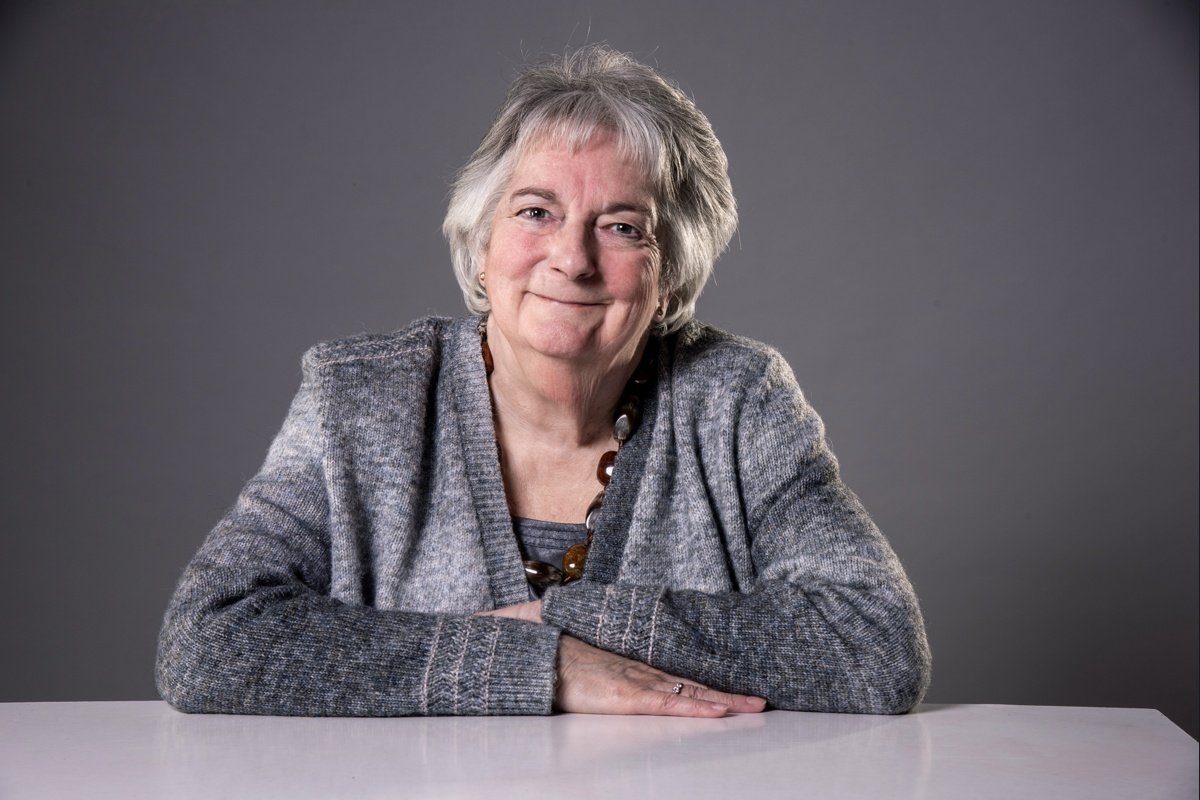
Lindsey Davis makes ancient Rome feel like a place inhabited rather than a civilisation observed from a respectful distance. Her interest in its streets, work, politics and social divisions gives her historical mysteries their energy, while humour allows the past to speak with an immediacy that solemn reconstruction can sometimes miss. She is admirably direct about her priorities: accuracy matters, but a novel must first be a story. That conviction runs through an interview rich in wit, independence and practical understanding of the craft.
The Silver Pigs introduced Marcus Didius Falco, whose world developed across twenty books before Flavia Albia offered another voice and another angle on Roman life. The Course of Honour and Master and God reveal the range of Davis’s historical interests, while Murder in Purple and Gold turns towards the competitive spectacle of charioteering. Her attention to intelligent, independent women is particularly striking in a field so often dominated by soldiers and emperors. Davis speaks as an author secure in her own style and uninterested in fashionable prescriptions. Her advice is bracing, her affection for storytelling unmistakable, and her work a persuasive reminder that historical fiction can be rigorous, entertaining and wonderfully alive.
Interview by Ben Alan
Your Marcus Didius Falco novels have captivated readers for decades. What first inspired you to set a detective series in ancient Rome, and why did Falco feel like the perfect guide to that world?
I had researched the ancient city and it struck me that the streetlife and political set-up were perfect comparisons for the big metropolitan ‘gumshoe’ novels I had always enjoyed. Once I discovered that imperial Rome did have characters called ‘informers’ (delatores) who behaved like ambulance-chasing lawyers and were equally seen as disreputable, I thought I could use that as a device to create a freelance ‘detective’. Falco would need to observe his world, at all social levels, and his voice in my head had the right style.
After concluding the Falco series, what motivated you to continue exploring the same universe through Flavia Albia, and how has writing her differed from writing Falco?
I had written 20 books about Falco and Helena and, since I deliberately don’t do stories that are all basically the same, I felt I had said everything I wanted to say in that series and should stop. I had been writing as a man, in the first person, all that time and was eager for change. Albia would be set in a different period (12 years later and ongoing) so Rome was different, as were the places and people readers already knew. She then has the advantages that she’s female and she’s an outsider from Britain so looks at the city and traditions with a more critical attitude than Falco, who scoffs, yet is a Roman traditionalist.
Ancient Rome is vividly realised in books such as The Silver Pigs, Venus in Copper and The Ides of April. How do you balance historical accuracy with the demands of an engaging mystery?
A novel has to be a story first. I like to be historically accurate or, for me, what is the point? However, I am not writing textbooks, so although readers are entranced by colourful details, I need to use only what is necessary to illuminate the Roman world convincingly. My job is to show how the Romans were the same as us, and how they were different. But I am taking my readers into a different milieu, away from their own stressful present life, for relaxation and entertainment, even sometimes for solace if they are ill or bereaved; for that they need a story about people, what they are like and what they do. The factual history gives depth but that’s not the primary reason for writing or reading these books.
Your novels often blend intrigue, humour and memorable characters. How important is humour in bringing history to life for modern readers?
I write in the only way I know. This is my style, which I can’t change. Humour has made it difficult to get published and I know that in literary and reviewing circles anything less than earnest is seen as an inferior commodity. I disagree. So do my readers. So, for me humour is vital.
Which of your books surprised you the most while you were writing it, perhaps taking the story or characters in an unexpected direction?
‘Master and God’, one of my standalone novels, taught me that like the Emperor Domitian I was myself a paranoid tyrant… I did find I ended up explaining him, though never excusing him; since he was clearly intelligent, many events in his story are reprehensible and he should have known it. That gave a tension I didn’t expect originally, and I think made it a better, more enjoyable book.
My most recent novel was a surprise because I thought I didn’t want to get to know the subject: ‘Murder in Purple and Gold’ started life as trying to write about Roman charioteering as if it was Formula 1. I am basically a snooker fan, so had to grasp a different sport; I was surprised by how easily the book came together and, again, how much I enjoyed playing with that world. Not that I want to go back to researching loud vehicles endlessly racing around in circles…
Many readers feel that Rome itself is one of your central characters. What places, traditions or discoveries have most influenced your portrayal of the ancient world?
That’s a nice concept. I am a city girl so it’s city life I naturally seek out. Rome and the Bay of Naples obviously are my key inspirations, especially that wonderful time-capsule of what was destroyed by the eruption of Mount Vesuvius. I have never written, as so many authors do, concentrating on the upper classes (who were in fact a very small part of society) as if the aristocracy were all that mattered. Their relevance is like that of celebrities today. I am seeing it all from street level, especially those many evocative shops and bars. My portrayal is typically about a social cross section, not so much ‘classical’ Latin but from the viewpoint of archaeology.
Over the years, how has your approach to researching historical fiction evolved, and has there ever been a discovery that completely changed a storyline?
I think my basic approach has stayed the same, partly because I have always done my own thing, written in my own style, covered my personal choice of material, whatever fashion dictated. I like to keep up to date so I do adjust for new discoveries. The best was when archaeologists from the Museum of London found some previously unknown Roman waterwheels, which I immediately wrote into the book I was working on; unfortunately they later changed their minds about how the wheels operated, but it was too late for my manuscript.
I’ve more often pre-empted things that subsequently happened, eg when the Berlin Wall came down, or when I learned about an Australian serial killer who put body parts into the water system. The most upsetting has been when I described Nero in terms that became hideously apt for an American President…
Looking back across your career, is there one novel that holds a particularly special place in your heart, and if so, why?
You always love your first published novel, so The Silver Pigs, which started the Falco series, is very special. But The Course of Honour, about the Emperor Vespasian and his mistress/partner was written before that and I think is perhaps my best book. Rebels and Traitors allowed me to move back to my ‘real’ period, the English Civil War.
Historical fiction continues to enjoy enormous popularity. What do you think readers are searching for when they immerse themselves in stories set in the distant past?
Escape, enjoyment, and easy learning.
Your books feature strong, intelligent and independent women alongside unforgettable investigators. How important has it been for you to challenge assumptions about life in ancient Rome?
Vital. For centuries Rome was described by men, for men, and about men. There are still too many male authors writing about soldiers and gladiators, too many books where they only include females if they are going to be raped, too few books and documentaries that forget women form 50% of the population at all times. All those famous Roman men had mothers, sisters and wives. Many of those women had resounding personalities. The Roman social unit was a family – with an equal male/female partnership at its heart… I could rant on!
What writing habits or routines have helped you remain so consistently productive throughout your career?
Obviously I think getting up to write 3000 words before breakfast is nonsense and torture, so people who say they do it are probably lying. Writing novels should be fun, and in my house it is. That’s why people like my books. Meanwhile, I’ve always written to pay the mortgage or, now, plan for a care home. People ought to have jobs, and this is mine. Mainly I write because I want to, so that’s why even at retirement age I haven’t stopped.
After so many acclaimed novels, are there still stories from Roman history that you are eager to explore in future books?
I tend to make up my own stories, so what I shall eagerly explore will be come from my own creative imagination. But if I need or want to illustrate from history, well that’s an added layer of interest that I won’t refuse.
What writing tips would you share with aspiring authors who hope to write compelling historical fiction?
Finish the manuscript. Write a good book, with authority and confidence, then write another, and another.
Forget showing off your academic learning; learn how to write the real essentials: plot, characters, dialogue, description and atmosphere.
Expand your vocabulary. Understand punctuation. Never use AI for creative work. Finish by your deadline. Read your contracts. Check royalty statements. Do your accounts and pay your tax.
Have ergonomic desk equipment.
Don’t drink and type.
Don’t try to write books that are ‘in the style of Lindsey Davis’. You can’t. Write your own.
If Marcus Didius Falco and Flavia Albia could interview each other for a day, who do you think would end up asking the better questions?
I believe their questions would be slightly different in approach but equally tenacious.
If you could spend twenty-four hours anywhere in ancient Rome, where would you go first, and what would you absolutely avoid?
I’d go to the Aventine, the plebian hill, to see if I had got it right. I’d probably avoid the Imperial Palace.
Which historical figure from ancient Rome do you think would make the most entertaining dinner guest, and why?
I’d like to meet Vespasian’s mistress and partner, Antonia Caenis.
If your characters could read one of your novels about themselves, who would complain the loudest about how they were portrayed?
Anacrites, the evil Chief Spy, Falco’s Nemesis. But he wouldn’t bother to complain, he would simply redact everything said about him, on grounds of security. Source: Reader’s House