

Lawrence Goldstone, novelist and narrative historian, discusses the people and ideas behind his writing. Image source: Lawrence Goldstone’s official website; photographer credit not supplied.
Looking Beyond The Myths Of History
Lawrence Goldstone discusses the experiences behind his writing, challenges historical myths, explores constitutional injustice and technological ambition, and shares insights into research, fiction, perseverance and the continuing evolution of storytelling.
Lawrence Goldstone approaches history with a novelist’s interest in character and a researcher’s distrust of easy explanations. In this conversation, he describes a writing life shaped by work beyond the desk, from acting and teaching to driving a New York taxi.
His answers return to the tension between public legends and the people beneath them. Across constitutional history, technological invention and historical fiction, he argues for context, challenges comforting myths and reflects on the persistence required to develop a voice.
“Lawrence Goldstone brings restless curiosity, intellectual courage and humane insight to stories that challenge assumptions and illuminate our shared past.”
– Reader’s House Editorial Desk
Your career has taken you from Wall Street and acting to policy analysis and writing award-winning books. How have those diverse experiences shaped the way you approach storytelling?
“I value breadth.”
– Lawrence Goldstone
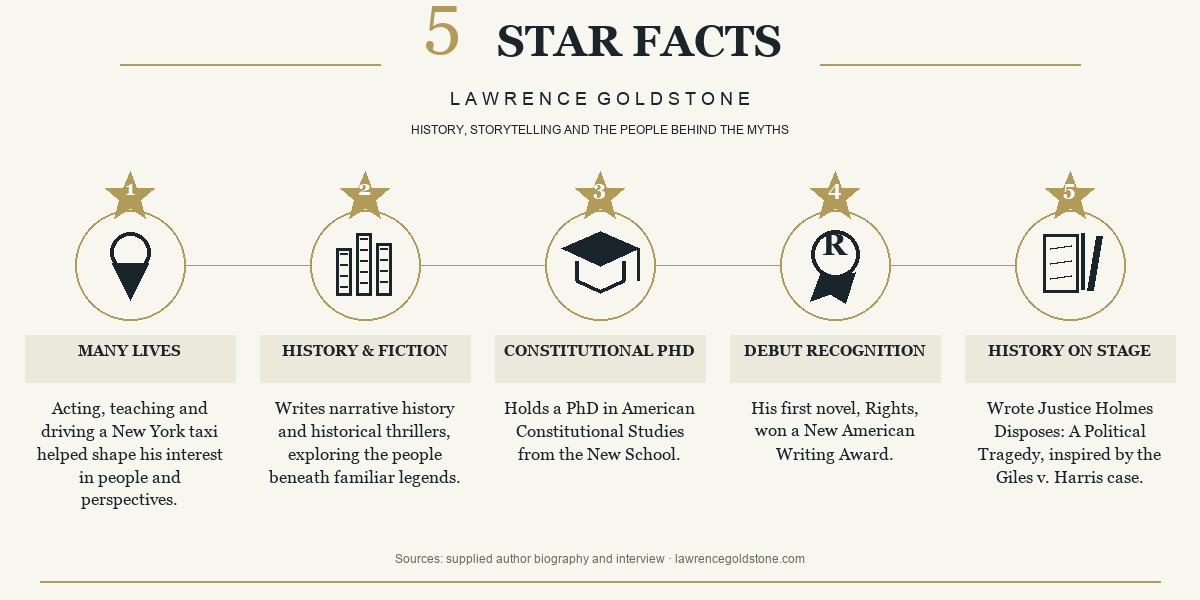
I suppose you could say that in life, as with my writing, I value breadth. Depth is important too, of course, but depth without breadth ignores context, which, to me, works to the detriment of understanding. Each of the varied experiences I’ve had, which also include acting, teaching, and driving a New York City taxi, has exposed me to people and situations that could not help but make me more sensitive to a variety of perspectives. Everything a writer produces, fiction or non-, is a study in human behavior and the more that writers understand how people react to circumstances in a variety of contexts, the more effectively they can present an honest portrayal to the reader. That is what makes, for example, John Le Carré, one of my favorite writers, so compelling, especially in his earlier work.
Six Highlights From The Conversation
- A Varied Life Shapes A Writer’s Eye
- History Beyond The Comfort Of Myth
- Constitutional Ideals And Unequal Realities
- The Ambitions Behind Technological Change
- Research Gives Historical Fiction Its Grounding
- A Writing Life Built On Persistence
Your books span legal history, technology, biography, young adult fiction and historical thrillers. What draws you to exploring such a wide range of subjects rather than remaining within a single genre?
I’m attracted to people or events around which a significant mythology has grown, which, in turn, leads to revealing critical comparisons with the present day. Despite common perception and his own pronouncements, Henry Ford never invented anything, not the assembly line, not the $5-day, and certainly not the automobile. His cars were not even the best on the market. The Buick 10 was far superior to the Model T. But Ford was a brilliant manager. He had a preternatural ability to either hire or go into partnership with precisely the people he needed at a given moment, the actual innovators, who he would then discard when their usefulness ended. It was Walter Flanders, a hard-drinking womanizer, who designed the Ford assembly line. Ford, famously, did not drink, smoke, or philander, and loathed those who did, yet he overlooked these prejudices to hire Flanders. Same with his partnership with the Dodge brothers. And, although he was a vitriolic antisemite, Ford’s architect of choice was Albert Kahn. For me, seeing Ford as he was immediately evoked Steve Jobs and Bill Gates, neither of whom invented the device that made them rich. Elon Musk is another prominent example. These parallels are not confined to business or engineering. I discovered similar phenomena in my studies of the men who drafted the American Constitution and pivotal figures in Supreme Court history.
Your works on the history of the United States Supreme Court and equal rights have earned major recognition. What first sparked your fascination with this pivotal area of American history?
It began in graduate school. I’ve always been interested in Constitutional law, which, obviously, begins with a study of the Constitution itself. While perusing the record of the debates at the 1787 Constitutional Convention, I could not help but notice that slavery played a far more significant role in shaping the finished product than any scholar I read seemed to be cognizant of. The census being held every ten years, for example, was a compromise engendered by Southern delegates’ insistence that slavery be protected and it was fashioned at the exact same time as the infamous 3/5 clause. There was also, it seemed to me, a widespread misunderstanding of roles and positions of some key delegates, Alexander Hamilton, George Mason and John Rutledge, in particular. James Madison was nowhere near as influential as history has portrayed him. The Convention and its underemphasis of slave economics became the subject of my doctoral dissertation. I waited decades for someone else to write about it but no one did. So, in 2005, I published Dark Bargain, which was at the time, to say the least, highly controversial, but whose themes were subsequently picked up by a number of academic historians. That set me off to study the evolution of constitutional interpretation, both by the Supreme Court and among the general population, and how the changes manifested themselves as the country grew. The most significant divergence between the ideals we preached and politics we practiced…until now…occurred from the onset of Reconstruction in 1865 to full blossoming of Jim Crow in the first decade of the 20th century.
Books such as Dark Bargain, Inherently Unequal and On Account of Race explore defining moments in the struggle for justice. What do you hope modern readers take away from these stories?
The main lesson I hope to convey is, at its core, how little has changed. I should say here that I am what should be referred to as a “narrative historian,” but what is often called by academics (disparagingly) a “popular historian.” Funny, nobody ever referred to the great Barbara Tuchman as a “popular historian,” although her approach is sort of the standard for what writers like me try to achieve. As such, in addition to giving readers the details of whatever I happen to be writing about, I’m also trying to elucidate parallels to what they are experiencing in their daily lives. For example, comparisons of the current Supreme Court with those of the late 19th century, when the justices used linguistic gymnastics to create a letter of the law that violated its spirit, are eerie. And the Constitutional Convention was not a colloquium of latter-day Athenians engaged in lofty debate about the principles of government, but a reluctant meeting of hard-headed pragmatists who generally did not like one another, there to protect the interests of their class and their states.
Your technology histories, including Drive!, Birdmen and Going Deep, reveal the people behind remarkable innovations. What attracts you to the intersection of invention, ambition and history?
Again, in the abstract, all these stories have a similar basis. Whether it is an inventor, a businessman, a political figure, or a Supreme Court justice, history tends create legends around which the development of an invention, a political system, or a body of laws evolve, and these are all too often misleading fables. When events or the people in them are the subjects of these distortions, the lessons we need to glean from history are distorted and perhaps lost entirely. This effect is not new, but now, with distortion becoming overt and an accepted part of national dialogues, the problem has reached critical proportions. Thus, when the new breed of tech entrepreneurs, the Zuckerbergs, the Brins, and the Bezoses, arrived, many people thought how refreshing it would be to have youthful energy break down barriers and supplant the staid old ideas that stifled progress. This new group would be cool, not like the 19th century robber barons like Ford, Rockefeller, and Carnegie. But that group was looked on the same way when they came on the scene and they evolved into the very people who built those barriers, just like today’s crew, is doing now. Plus ça change…
You have also written historical thrillers. How does writing fiction differ from writing meticulously researched non-fiction, and do you find one more creatively liberating than the other?
“My fiction is scrupulously accurate historically so the research is much the same.”
– Lawrence Goldstone
My fiction is scrupulously accurate historically so the research is much the same. But what makes fiction fun is creating conversations and events to bring someone or something to life and make the history breathe in a way that is not possible in non-fiction. On the other hand, sometimes a figure in history is so fascinating, so compelling, that the reader is best served knowing the real person without any hint that much of what they’re reading may be made up. A prime example is John Phillip Holland, the inventor of the attack submarine; another is the amazing aviator Lincoln Beachey, without question the greatest flyer who ever lived. His exploits were so incredible that they would not have been believed if he had not performed them before crowds that reached the hundreds of thousands.
Research is clearly at the heart of your work. Have you ever uncovered a historical fact so extraordinary that it completely changed the direction of a book?
That happens regularly. When I realized, for example, that the very first thing the Wright brothers did when they returned to Ohio was hire a patent attorney whose job it was to secure royalties not only from airplanes that used the Wrights’ design, but from every airplane built from then on, no matter what the technology, my focus on early aviation changed entirely. In addition, although Wilbur Wright had a brilliant insight, the technology they used was dead-end and within a few years had been totally supplanted and not one facet of their invention is currently used in modern aviation technology. Glenn Curtis, on the other hand, who has been largely lost to history, had a huge impact, which is still felt today.
After publishing nearly thirty books across multiple genres, how has your understanding of storytelling evolved since your first publication?
“experience is something you don’t think you need until you have some.”
– Lawrence Goldstone
When I teach, I often tell students that experience is something you don’t think you need until you have some. The process is gradual but should be inexorable. I don’t go back to old work that much anymore, but I will still review what I wrote that may be structurally similar to a current project. I’m always shocked at how much I see after being away from a book or an article even for a couple of weeks.
You have recently completed a stage play that received an enthusiastic staged reading. What inspired you to explore theatre, and how did the experience differ from writing books?
I have long been obsessed with an abominable 1903 Supreme Court decision, Giles v Harris, which doomed African American voting rights and ushered in the horrors of Jim Crow. I wrote about the case extensively in both Inherently Unequal and On Account of Race. What is fascinating and deeply ironic is that writing the appalling majority opinion was the revered champion of civil liberties, Justice Oliver Wendell Holmes, Jr, and secretly financing the challenge to the openly racist 1901 Alabama constitution was the supposed “accommodationist” Booker T. Washington. Even more compelling is that representing the plaintiff was Wilford H. Smith, at the time the first and only Black lawyer to ever win a case before the Supreme Court. I have always been convinced that here was stuff of great drama, so I decided to write one, which I called “Justice Holmes Disposes: A Political Tragedy.” And yes, the reading went very well although I saw the need for some serious re-writing, which I recently completed. The best part was during the talkback afterward, virtually everyone stayed and their enthusiasm was palpable and deeply gratifying. I, on the other hand, could only really think about what needed to be fixed.
Looking back across your remarkable career, which book challenged you the most, and which one remains closest to your heart?
That’s tough, like being asked to choose your favorite child. The most challenging is easy—it was my first one, Rights, a satire on racial politics in New York City. It had passion and, if I may say so, showed a decent amount of talent. Even won a New American Writing Award. But, alas, not a whole lot of craft. It would look a lot different if I wrote it today. But sections still sing to me. Of the recent work, I am most proud of either unearthing material that has been passed over by others, such as in, say Going Deep, or realizing that the meaning of widely recognized events is different than is commonly assumed, as in most of my work about the United States Constitution, especially Inherently Unequal, that I suppose I consider my best book.
What practical writing tips would you offer aspiring authors who want to write engaging history that feels every bit as compelling as a novel?
Read the greats, like Barbara Tuchman, but also brilliant fiction writers and then try to figure out what they do to both transmit information and create a narrative the propels you from page to page. But you also must create your own voice, your own style, and that means write and then write some more. Be prepared for rejection…it took me four years to get Rights published…and believe in your work while being merciless with yourself in finding flaws and improving.
What advice would you give to aspiring authors about building a long and rewarding writing career while remaining curious enough to keep exploring new subjects?
“You have to love what you do and keep doing it.”
– Lawrence Goldstone
You have to love what you do and keep doing it. I’m doing something for pay…sometimes…that I would happily do…in fact, need to do…for nothing. My first paying gig was a weekly op-ed for a small newspaper in Massachusetts for which I was paid the princely sum of $10. The advance for my first book, Rights, was $1,000, a sum I have yet to make back although the book won an award. But the joy of putting words to the page and poring through both the present and the past to discern what to write about is so integral to my soul that I cannot even consider what my life would be without them.
If you could spend one day with any historical figure you've written about, who would it be, and what question would you ask first?
Hmmm, there are so many and so much to learn, I really cannot choose.
Having worked in so many different professions, which former version of yourself would make the most interesting character in a novel?
Haha. That’s a tough one. Perhaps you should ask my wife. I hope she would say the current one.
If one of your books were adapted into a major film tomorrow, which would you most like to see on the big screen?
I think perhaps Deadly Cure. It’s a novelized version of the true story of the introduction in 1899 of the most successful legal drug in history, acetylsalicylic acid, and the most successful illegal drug in history, diacetylmorphine, as a cure for childhood coughs. The first was marketed as aspirin, the second as heroin. I even wrote a series pilot, which, alas, did not get picked up.
After researching so much history, what is one historical myth you wish people would finally stop believing?
That figures from the past were any more noble, any more removed from the practical questions of daily life, than are people today. As I said, we can only learn from the past if we describe as it was, not how we would have it be.
Book Spotlight — Deadly Cure

An intriguing historical premise, medical danger and moral urgency make Deadly Cure an inviting prospect for readers of intelligent suspense.
Set in Brooklyn in 1899, Deadly Cure follows a physician confronting a child’s death and a dangerous pharmaceutical mystery. Its premise brings medicine, commerce and accountability into sharp conversation, offering an appealing entry point for readers drawn to historical suspense and the uneasy relationship between innovation and power.
Find Deadly Cure on Amazon UK · Publisher’s book information
Discover more about the author and his work at lawrencegoldstone.com.