
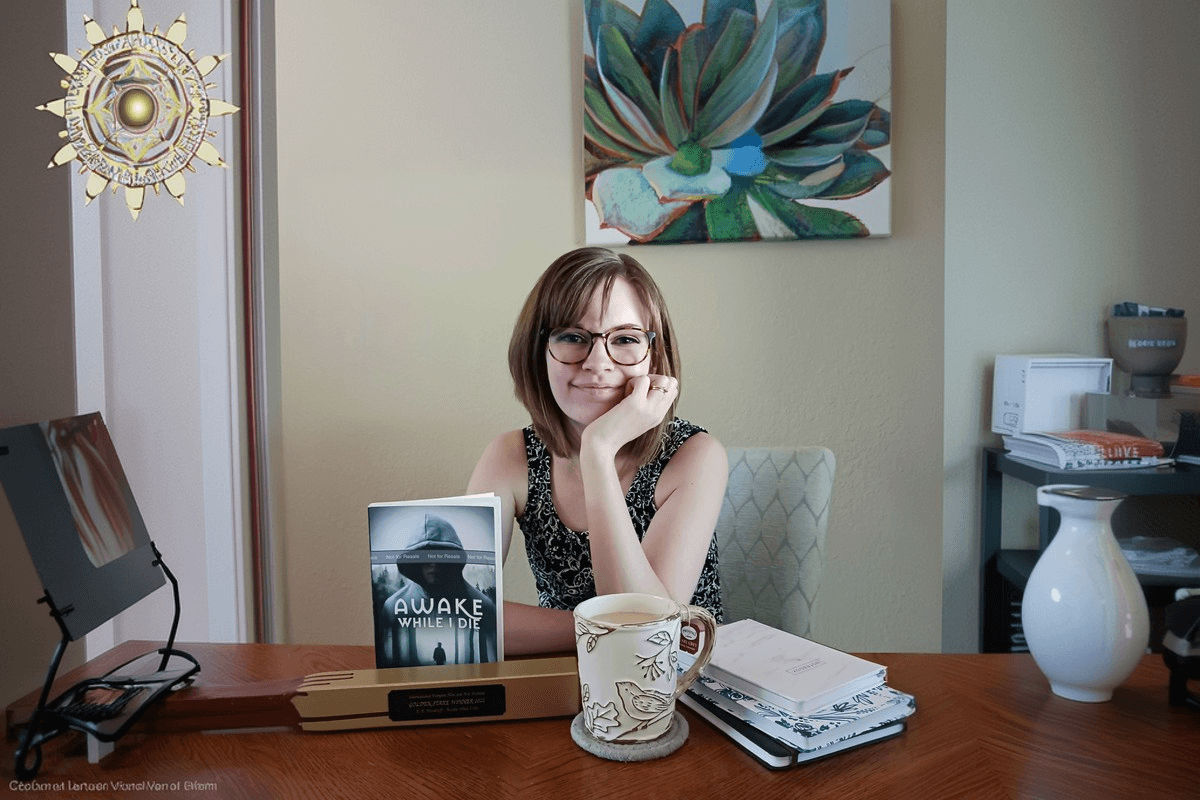
Photo: K.E. Woodruff, author of Awake While I Die, shares insight into her creative process and passion for storytelling.
Exploring Redemption Through Fantasy
K.E. Woodruff discusses her award-winning novel Awake While I Die, exploring themes of redemption, dark storytelling, her writing process, and balancing family life with a passion for creativity.
T he art of storytelling often lies in the intersection of the familiar and the extraordinary, where human emotion meets the uncharted depths of imagination. In this edition of Reader’s House, we delve into this intersection with author K.E. Woodruff, whose debut novel, Awake While I Die, merges the gripping allure of supernatural fantasy with deeply personal and human struggles. Winner of the Golden Stake Award at the 2022 International Vampire Film and Arts Festival, Woodruff’s work navigates themes of loss, redemption, and surviving darkness, offering readers both tension and solace.
In our interview, Woodruff opens up about the origins of her story, the construction of her richly layered characters, and the intricacies of crafting a contemporary vampire mythology. Balancing her writing with family life and finding moments of inspiration amidst the chaos, she offers insight into the challenges and triumphs of creating fiction that is both heart-wrenching and hopeful. For those curious about the creative process, the balance of light and shadow in storytelling, and what’s on the horizon for Woodruff, this conversation is certain to leave you inspired—and perhaps eager to lose yourself in her hauntingly compelling world.
K.E. Woodruff masterfully blends deep emotion, vivid imagination, and compelling characters, creating mesmerizing, heart-wrenching stories that deeply resonate.
What inspired you to write your first novel, Awake While I Die, and what do you hope readers take away from the story?
Many of my story ideas come to me as a single thought, such as a dilemma or a particular scene. In this case it happened to be the opening. I pictured a person (at first, I didn’t have a clear picture of who) walking into the woods and being attacked. Gradually, more details came to me: a boy, suicide attempt, vampires. And when the pieces finally came together, I had my first chapter and the inciting incident to move the plot forward.
The plot was simple, but the twist made me want find out more about Jason Harper. I asked myself, why did he want to die, and what stopped him from doing it? Awake While I Die isn’t just another vampire story; ultimately, it is a redemption ARC, and one that I hope inspires readers to find a way forward beyond their own personal darkness.
How did you develop the character of Jason Harper, and what do you think makes him relatable to your target audience?
Awake While I Die focuses on the main character, telling its story through the eyes of the “monster.” Although the book is very much fantasy, to me it has always been contemporary fiction, first and foremost. I wanted readers to see Jason as a person, broken and confused, rather than just a blood-thirsty creature of the night. Many of Jason’s personal struggles, such as loss, grief, and regret, are difficulties that we all face.
Your work often explores dark themes, what draws you to this type of storytelling and how do you balance it with more heartfelt moments?
Dark themes are incredibly powerful in the art of storytelling. Not only do they give the story and its characters a greater depth and sense of realism, but also they allow you as the writer to explore more personal subjects.
To be honest, Awake While I Die was incredibly difficult to tell. How do you handle sensitive topics like depression and suicide, while also crafting a vampire tale? As it turned out, the answer presented itself through the other characters of the book.
During Jason’s journey, he makes new friends, falls in love, and finds a father figure in his mentor. These are the pieces of the story that not only allow the reader to breathe, but also develop the main character as a living, breathing person, rather than just a placeholder. As much as I enjoy dark themes, I feel that it is necessary to balance out the gravitas with the promise of hope, a sweet exchange, or a moment of laughter.
“I wanted readers to see Jason as a person, broken and confused, rather than just a blood-thirsty creature of the night.” – K.E. Woodruff
Can you tell us about your writing process, do you have any specific routines or habits that help you stay focused and productive?
If I could pinpoint the one habit that helps me with productivity, it would be: never start with a blank page.
My writing style is what the writing community labels as a pantser. In other words, I discover my story alongside my characters, and together we find out what happens next. Making notes on my phone or jotting down an idea in a notebook before I sit down to write helps tremendously. If I can have an opening line, a scene idea, some conversation between two characters, I can move forward. But everything hinges on that starting point!
How do you manage to balance your writing career with your family life, particularly with young children and pets to care for?
In my current stage of life, there is no time for writing unless I make time. This usually looks like writing at 11:00 pm, as I am doing right now. Or it can mean locking myself away in a separate room while the kids play loudly at the other end of the house. Needless to say, life is full of noise and chaos and messes right now, but there is also a quiet moment of the end of each day that I am able to write a few words if I am willing to look for it.
“Many of Jason’s personal struggles, such as loss, grief, and regret, are difficulties that we all face.” – K.E. Woodruff
What research did you undertake to create the vampire mythology in Awake While I Die, and how did you decide on the rules and limitations for your supernatural world?
Much of my mythology stems from the classic take on vampires. Sources such as Bram Stoker’s Dracula were a key influence. However, one of my biggest inspirations came from the 2004 film Van Helsing. While there are differences between the vampires of my book and the vampires from the movie, I especially liked the way that the vampires transformed in Van Helsing. How they went from beautiful mortals to hellish creatures.
I decided to take it a step further by allowing my vampires to turn into shadow, a result of the vampire’s dual nature. The more a vampire feeds, the more beast he becomes, until finally losing himself. Jason encounters this very thing at one point in the story, and shadows begin to appear on his skin, a visible sign of his humanity slipping away.
Another set of limitations I placed on my world was the vampire Council. These are vampires who act as judge and executioner over the other vampires to ensure that order is kept, and none of the other members go rogue. With vampires in existence for hundreds of years, it only made sense for there to be some sort of system in place to keep them in check – though it is not without its flaws…
“If I could pinpoint the one habit that helps me with productivity, it would be: never start with a blank page.” – K.E. Woodruff
Are you working on any new projects at the moment, and if so, can you give us any hints about what we might expect from your next novel?
I have several projects all in varying stages of completion. One that I have been working on for several years is a YA paranormal/psychological thriller. It has a mysterious house in the swamp, a cursed family, and a misleading narrator. This story is currently undergoing a second round of edits, and I am excited to eventually share this story with everyone.
What advice would you give to aspiring authors who are just starting out on their writing journey, and what do you wish you had known before you began writing your own novels?
My advice to aspiring authors is to read. It doesn’t have to be a particular genre or author, just read. And read critically. Analyze your favorite stories – what makes them good? Did you like the characters? Was the plot clear? And analyze the stories you don’t enjoy. I’ve heard it said that bad stories are the best teachers. Figure out why you dislike a book, and figure out how you would make it better.